
 LU konference
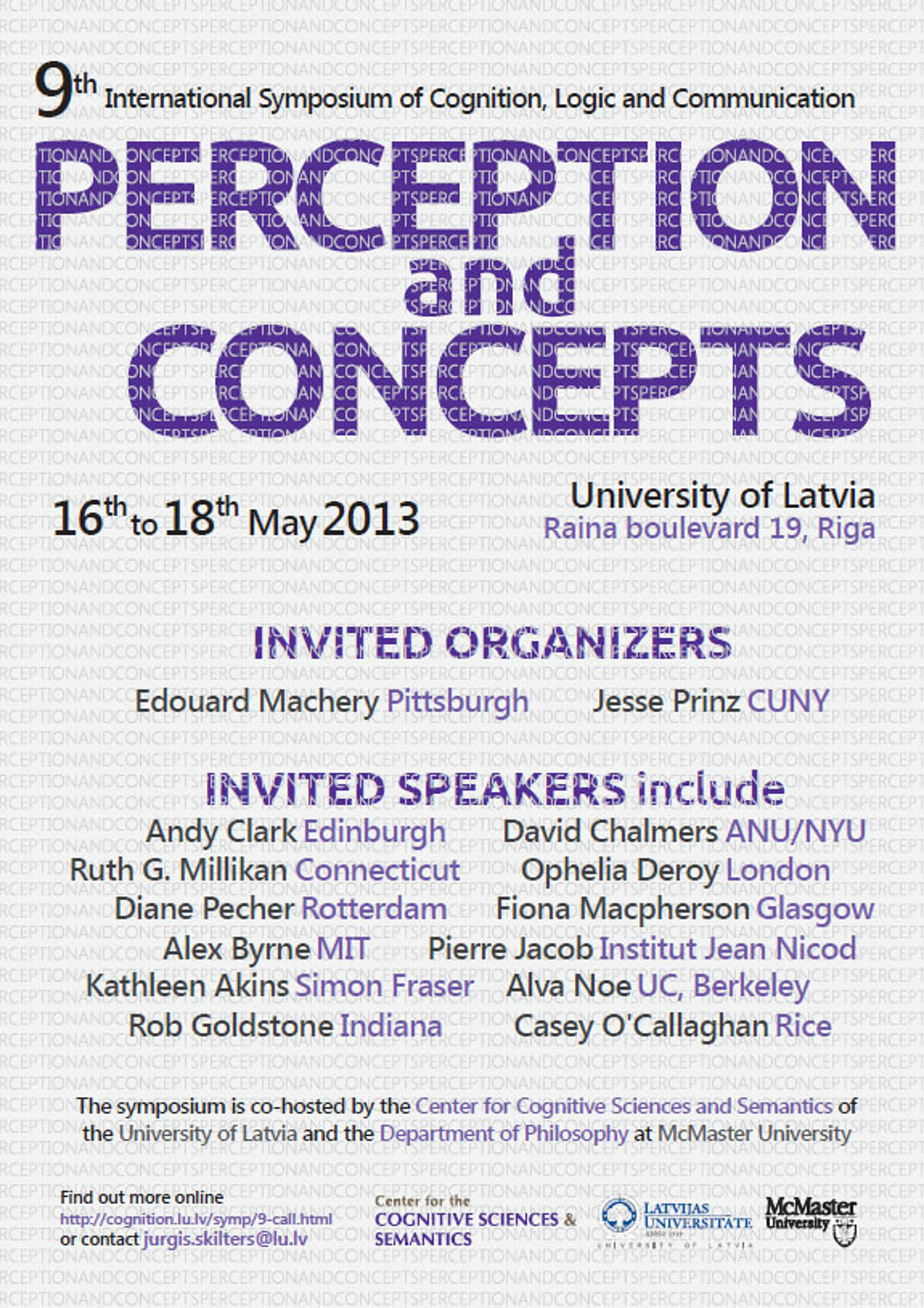
The symposium participants will mainly focus on issues regarding the relation between perception and concepts (knowledge structures). For example, whether the concepts are related to one’s perceptual experience or perceptual experience depends on the concepts one has, and whether the perception is possible without any concepts.
This year, the invited organisers are the researchers of perception and concepts from the USA, Edouard Machery, a professor of the University of Pittsburgh, and Jesse Prinz, a professor of the City University of New York.
The invited speakers are prominent cognitive scientists, such as David Chalmers, a professor of the Australian National University and visiting professor of the New York University (USA), Andy Clark, a professor of the University of Edinburgh (UK), Rob Goldstone, a professor of the Indiana University (USA), Alva Noë, a professor of the University of California, Berkeley (USA), Casey O'Callaghan, a professor of the Rice University, and others, whose work is important to the topic ‘Perception and Concepts’.
Professor Chalmers’s contribution is mainly related to the consciousness issues, which are among the central issues in the philosophy of mind. His colleague, Professor Clark, with whom Chalmers worked on the thesis of the extended mind, represents the direction of cognitive science, which studies embodied cognition. The main thesis of this direction is that cognition is happening in the interaction between the mind, the body (brain) and the environment. Professor Noë’s theoretical views are also associated with the embodied cognition paradigm, and his active theoretical work is devoted to the problems of perception. Professor Goldstone represents the field of cognitive psychology. He runs an interesting Percepts and Concepts Laboratory. You can find more information on this laboratory as well as participate in an online experiment by visiting cognitrn.psych.indiana.edu. Professor O’Callaghan will focus on multimodal, sound, speech, and art (in the broad sense) perception. At the symposium, he will deliver a report on the perception experience and its relation to the various senses.
‘This is the largest symposium we have ever organized. Several years of work have resulted in bringing together the most important concepts and perception researchers to find answers to a variety of vitally important questions on the nature, sources and forms of expression of human knowledge as well as their relation to the perception and senses. We are pleased that the symposium will be interesting for representatives of different fields,’ says Jurģis Šķilters, the director of the UL Centre for the Cognitive Sciences and Semantics and one of the symposium organizers.
Several of the symposium events will be broadcasted live on the University website, while on May 15 at 16:00, Professor Goldstone will give an open lecture at the UL Great Hall.
Programme
Home page Translated by students of the professional study programme Translator of the University of Latvia.
Home page Translated by students of the professional study programme Translator of the University of Latvia.
 will hold the 9th International Cognitive Science, Logic and Communication Symposium ‘Perception and Concepts’, organized by the UL Centre for the Cognitive Sciences and Semantics in collaboration with the Department of Philosophy at the McMaster University (Canada).)