
 LU konference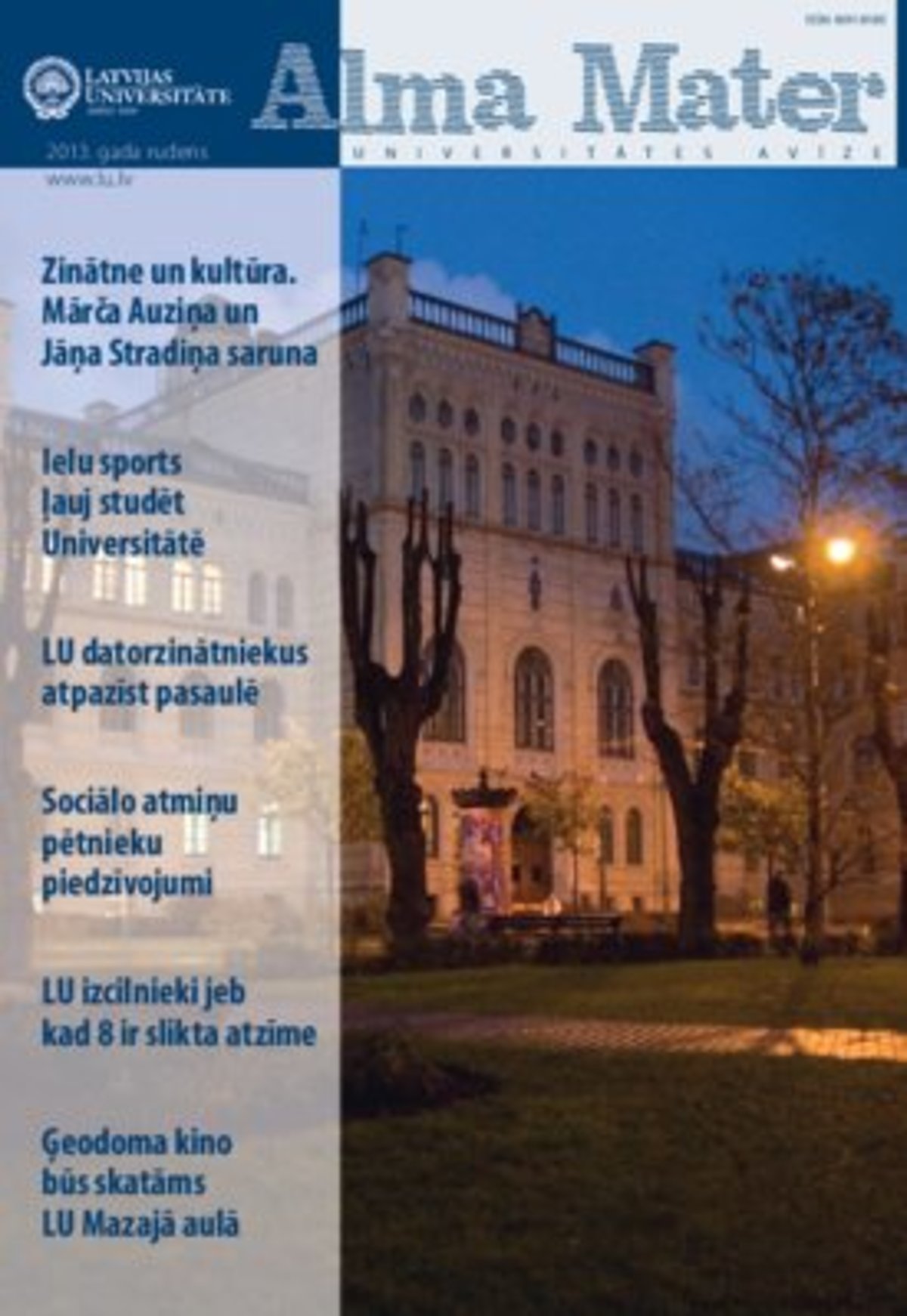
Jānis Stradiņš and Mārcis Auziņš: Culture in Science and Science in Culture
In a talk about the interaction between science and culture, UL Rector Mārcis Auziņš and academician, science historian Jānis Stradiņš talk, among other things, about the academic conference Interaction between Science and Culture in Latvia and the World. Scheduled to take place in December, the conference is planned as a celebration of Stradiņš’ 80th birthday. The professors discuss the elements uniting culture and science, the popularisation of science in a form easily understood by the society, the role of the humanities in Latvia, as well as the fact that, in Latvia, a scientist’s creative personality plays an important role in the sciences.
Ghetto Games Grant Holders; towards Academia with Street Sports in their Blood
For the second year, the UL cooperates with Ghetto Family to search for the most active and talented street sports and culture representatives. Everyone who has street sports in their blood gets a chance to take part in the Ghetto Games grant competition. The young participants prove their athletic talent and social activity competing for an opportunity to study at the UL. The aim of the grant is to provide the best athletes participating in Ghetto Games with financial support and a chance to study at the UL.
Learn about Climate Change in an Inflatable Cinema
In September, the UL will host the international conference Adaptation to Climate Change in the Baltic Sea Region, organised as part of the Baltadapt project. During the conference, the Small Hall of the UL will offer anyone a chance to visit the Gedome, an inflatable cinema. The cinema features short films on climate change, projected on the ceiling of the inflatable cinema, as well as other interactive activities. The Geodome has arrived from Sweden to Latvia in a small box. Inflated it holds 25 viewers at a time.
Donation-funded UL Organ Needs Restoration
After a 112-day UL campaign of raising funds for an organ, its consecration concert took place on 11 April 1937 when audiences were delighted by the sound of the UL organ for the first time. For 76 years, the UL organ has carried the symbolic significance of solemnity, festivity, as well as spiritual and cultural heritage. This year has seen the beginning of the arduous work of restoring the organ. Scheduled to be finished until the 95th anniversary of the UL, restoration is necessary so that the organ might delight the audiences of all graduation ceremonies, celebrations and concerts.
High Achievers: When Only the Top Grades Count
Some call them swots; others refer to them as superhuman. Some are envious and still others feel inspired and wish to emulate them. They are the UL high achievers—students who truly enjoy what they are studying and doing in life. These are stories of five excellent UL students who, in addition to receiving various grants and top grades in their studies, have found a field that is both challenging and rewarding.
Latvian Computer Scientists Recognised Globally
In July, Latvia hosted its first International Colloquium on Automata, Languages and Programming (ICALP 2013), which is the most prestigious theoretical computer science conference in Europe. Latvia was deemed suitable for the 40th anniversary conference due to the fact that Latvian scientists have gained international recognition in several fields of computational science and are considered the leading experts in some of them. Luca Aceto, President of the European Theoretical Computer Science Association, has particularly highlighted the achievements by Professors Rūsiņš Freivalds, Andris Ambainis and Kārlis Čertāns. Computer science is a dynamic and developing academic field that requires new experts in both the scientific and practical field. Therefore, it is no surprise that this year the UL Computer Sciences study programme has received the highest number of student applications.
Adventures of Memory Researchers
Social memory, or the use of the past in the present, is an essential part of our identity. It is studied at the Social Memory Research Centre (SMRC) that operates under the Institute for Political Research at the UL Faculty of Social Sciences. The SMRC carries out interdisciplinary research into collective memory, history and memory policy, past representation in the media and culture, as well as the interaction between memory and identity. UL researchers study the role of the past in the present not only sitting at their desks, but also by carrying out fieldwork. They collect data by observing events, people and collecting stories significant to one particular person and the society as a whole. UL researchers Laura Ardava, Didzis Bērziņš, Kristiāna Kirša, Klinta Ločmele, Aija Rozenšteine, Gita Siliņa, Laura Uzule and Professors Vita Zelče and Andrejs Plakans (USA) present their experience.
To Get Acquainted with Studies during Spare Time after School
With the support of several UL faculties, UL Youth Universities offer school pupils a chance to get a taste of study life during their school years. UL Youth Universities have gained widespread popularity and pupils are even ready to wake up early on Sundays to study. This year, the existing UL Youth Universities will be joined by three new ones: the Young Theologian and Religion Researcher University, Young Lawyer University and Young Entrepreneur University, which has already gained great popularity this spring.
Scientists to Receive Help Starting a Green Business
In order to support companies in the development of new products and promote the establishing of innovative green-technology businesses, the University of Latvia, Riga Technical University and SIVA, the Norwegian Corporation for Industrial Development, have joined forces and taken the first steps for a Green Technology Incubator in Riga this autumn. The incubator will support new business ideas, put forward by students or scientists, and help existing companies develop new products.
International Experience for a More Advanced Library
Everyone has a different idea of what characterises a state-of-the-art library. Some mention a modern interior and a multitude of books, while others would like to access the library externally and make electronic use of all the available resources. All of these answers are certainly correct. Experience gained in a number of international projects has allowed UL library staff to increase their work efficiency. For example, the waiting time for a book ordered at the UL library is five minutes, while the Tartu library requires up to two hours. UL library staff speak about the interesting experience that they have gained participating in six projects at different libraries in universities abroad.
100 000 Records in the History and Science of the University of Latvia
The UL (University of Latvia) Database for Scientific Publications and History has been created with the aim of collecting information on books, scientific articles and other publications by UL employees. The database also contains history of the UL: information on research and teaching activities, events and personalities. It currently holds bibliographic descriptions of more than 100 000 publications. The publications date from 1852 to the present day and mostly cover social sciences and humanities. In May 2013, the database was linked with the UL information system. This offers UL staff the opportunity to add their own publication descriptions.
The UL (University of Latvia) Database for Scientific Publications and History has been created with the aim of collecting information on books, scientific articles and other publications by UL employees. The database also contains history of the UL: information on research and teaching activities, events and personalities. It currently holds bibliographic descriptions of more than 100 000 publications. The publications date from 1852 to the present day and mostly cover social sciences and humanities. In May 2013, the database was linked with the UL information system. This offers UL staff the opportunity to add their own publication descriptions.
