
 LU konference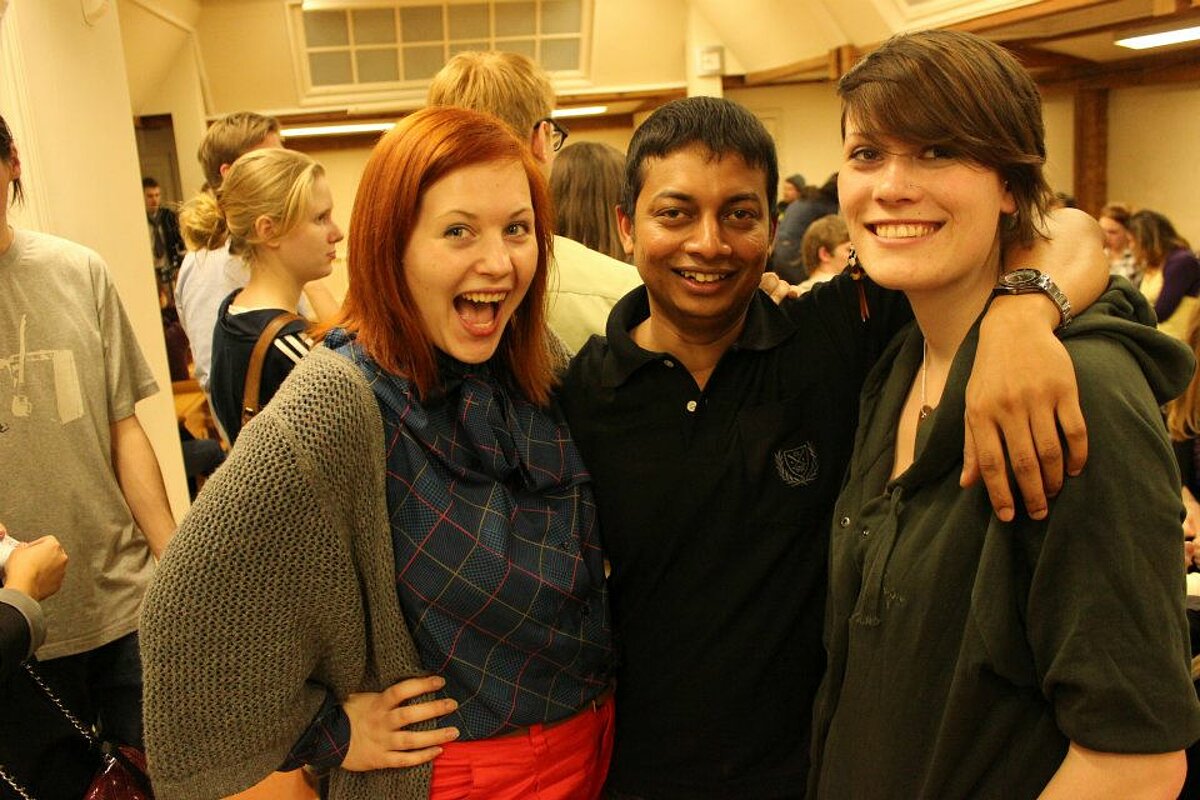
Upon the UL Student Council’s initiative, an international and informal language learning program has been launched in order to help Latvian students get to know their foreign counterparts and learn their language and cultural peculiarities. This year, the Couple Learning Programme (CLP) is celebrating its fourth year of operation.
This year, the Couple Learning Programme has been organized for the seventh time and has gained wide recognition among students. Its main purpose is to give opportunities for foreign and Latvian students to meet and learn each other’s languages. ‘The programme uses a teaching method called ‘students studentam’ (from student to student), according to which students are divided into pairs so that they could teach each other their language and culture and informally spend time together,’ says Rihards Blese, the head of the UL Student Council Foreign Affairs.
Going beyond the borders
During this year, exchange students from 30 world countries who study in the spring semester at the University of Latvia, the Riga Technical University and the Riga Stradiņš University have joined the programme to learn the Latvian language, culture and people.
‘Considering, that now all borders within the European Union are open, language skills open up new opportunities for students. We offer language learning in students’ way by removing the restrictions of the formal approach to learning,’ points out Normunds Buivids, the head of the programme in 2012.
Learning in pairs
The length of the programme is three months during one semester; the participants attend the formal, so-called control meetings about once in two weeks as well as meet informally in pairs to learn languages and make contacts communicate with students from different countries and cultures. Although the aim of the programme is the informal language learning, curiosities happen every year as well, for example, when foreign students apply to find their future wife or husband.
One of the programme participants, Kristīne Petrovska, recommends the students not to be lazy and take part in the program because it provides new opportunities that are just around the corner. ‘I participated in the CLP or, as the Latvians call it, kaplis in the end of the autumn in 2012,’ says Kristīne. ‘I was surprised to see students' desire to meet late in the evening and their enthusiasm to do homework, jointly explore the Latvian culture and learn different languages. The thing I remember the most was the telling of fairytales that were narrated by one of counterparts and translated by the other into their native language. The pairs didn’t just attend the control meetings but also visited different traditionally Latvian places on their own and learned each other’s cultures. I am glad that among the participants there are always students not only from European countries but also from less known parts of the world including South Korea, Azerbaijan, Taiwan and many others.’
Learning exotic languages
This year, Latvian students have showed the most interest in learning German, French, Spanish, English, Italian and Russian language. The Scandinavian and Baltic languages have been in demand as well, and, during the last few years, there have also been increasing trends of learning Japanese and Chinese. While in the program, the students learn such exotic languages as Hindi, Turkish, Sinhala, Korean and Icelandic languages.
‘In addition, the programme is closely linked with the issue of the integration of foreign students into the Latvian higher education environment, which is extremely important for the Latvian higher education institutions. It speeds up the adaptation of foreign students in the local community, whereas the Latvian students have a great opportunity to learn foreign languages, cultures and mentalities, as well as make new contacts,’ says Rihards Blese.
Everyone is invited
This programme has been created upon the UL Student Council’s initiative and is being implemented in cooperation with the Riga Technical University Students’ Parliament and the Riga Stradiņš University Students’ Government in order to promote the exchange of experience and knowledge between students from different countries and cultures.
The next application for the Couple Learning Programme will be held at the beginning of the autumn semester; for more information on how to apply visit www.lusp.lv.
Experience
Andris Loks, one of participants, shares his experience:
‘The recent CLP control meeting at the UL was very exciting: it was organized as an extemporaneous concert Couplevision (a derivation of Eurovision). Divided into teams, we made up the choreography, selected the artists and gave performances accompanied by the chosen music. In teams, we spoke different languages: Latvian, English, and other, as well as mastered the body language. The principle of the event was similar to that of a lip-sync contest, which, by the way, is a popular event at schools in Latvia and is called Popiela*. It was exciting to select a melody that everyone would know and like because the team members were from different countries. The concert was funny and interesting; each team had created something special. The organizers prepared a performance as well, which encouraged and cheered us up. I enjoyed our concert, got a lot of positive emotions and spent a good time. After the concert, we went to some cozy place and played Mafia, which has become a traditional CLP game.
* Popiela is an entertaining lip-sync event held at schools in Latvia, where pupils imitate their chosen singer and melody as attractive as possible.
Translated by students of the professional study programme Translator of the University of Latvia.
, and you will hear conversations in many languages of the world all round. For several years now, foreign students have been studying here along with their Latvian peers. )