
 LU konference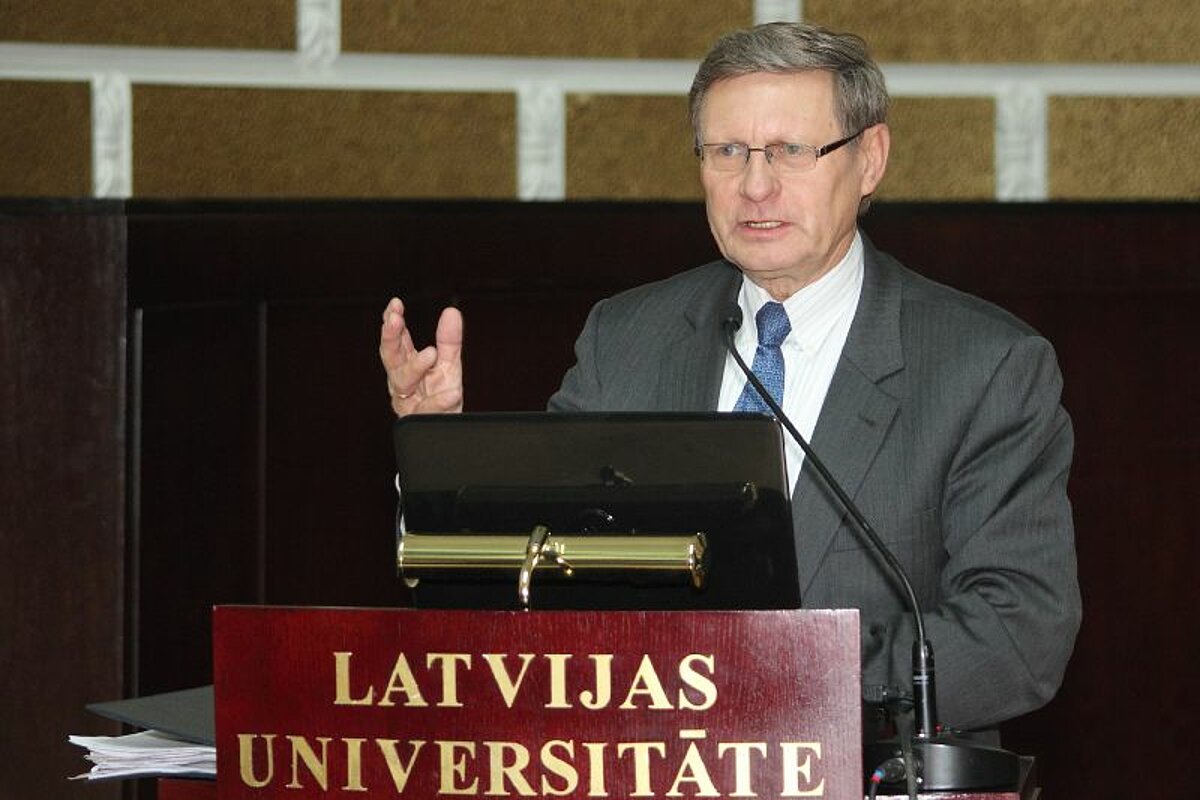
Leszek Balcerowicz, who is Poland’s free market reforms founder with a central banker experience, devoted most of his speech to the current crisis in the euro area, its causes and solutions, pointing out that the systematic budget overruns at the expense of the growing state debt was one of the causes of the crisis, but the solution in most cases lies in the austerity policy combined with the reforms to facilitate business and not with the raising of taxes.
To Balcerowicz’s opinion, the Baltic countries’ transition to the euro is a logical step. ‘The Baltic countries’ decision to peg their national currencies to the euro has been right for small countries equally dependent on export and import, and now Latvia’s transition to the euro, following Estonia’s example, would be a logical step that would not mean any drastic changes,’ said Balcerowicz. ‘Poland had a floating exchange rate policy and, we shall experience the transition to the euro as a revolution, while you have already gone through it.’
Professor Leszek Balcerowicz is considered to be the founder of Poland’s economic reforms. In 1989, he created and implemented Poland’s radical economic stabilization and transformation program. Professor Balcerowicz was the Polish Deputy Prime Minister, the Minister of Finance, as well as the president of the National Bank of Poland. Since 1992, he is a professor at the Warsaw School of Economics. Leszek Balcerowicz is an honorary doctor in more than 20 universities around the world. He advises the European Systemic Risk Board and works for other international advisory boards.
Translated by students of the professional study programme Translator of the University of Latvia.
, Leszek Balcerowicz, a professor of the Warsaw School of Economics and one of today’s best-known economists of Poland, gave the lecture ‘Euro: Problems and Solutions’. In this lecture, which was organized by the UL and the Bank of Latvia (BL), the professor expressed his approval of the current Latvian economic trends and the now-possible transition to the euro, as well as analysed the current situation of the euro area.)