

In Riga, UL ERN activities will take place at the UL Academic Centre in Torņakalns, the institutes under the UL Faculty of Humanities in central Riga, Friedrich Zander’s childhood home in Šampēteris, the Institute of Solid State Physics of the UL in Ķengarags, the UL Botanical Garden in Dzirciems and the Riga Photonics Centre in the Old Town. Outside the capital, visitors will be welcomed at the UL Baldone Observatory in Riekstukalns and the UL Ornithological Research Centre in Pape.
This extensive network of venues will offer visitors the chance to explore a wide range of scientific fields in a single evening – from quantum technologies and artificial intelligence (AI) to astronomy, nature research, language and culture. Curious minds of all ages will be able to meet researchers, take part in experiments and workshops, and enjoy science and art performances. Science will unfold across five thematic areas: “Light and Matter”, “Voices of Atoms”, “The Art of Data”, “Living in the Future” and “The Science Stage”. The full programme is available on the UL website.
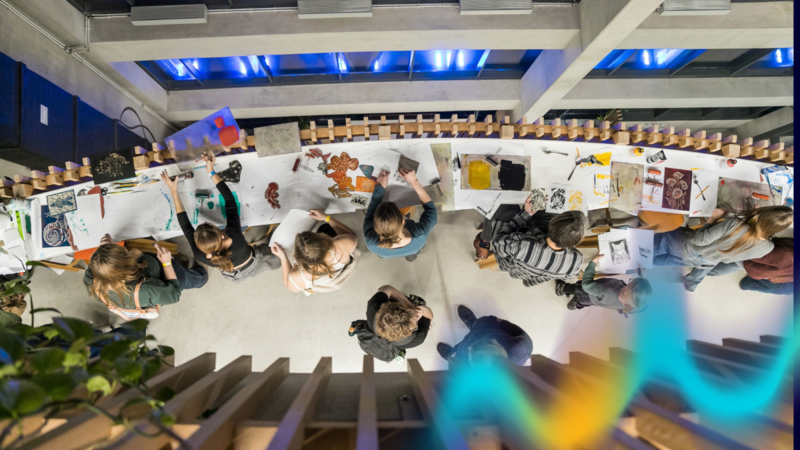
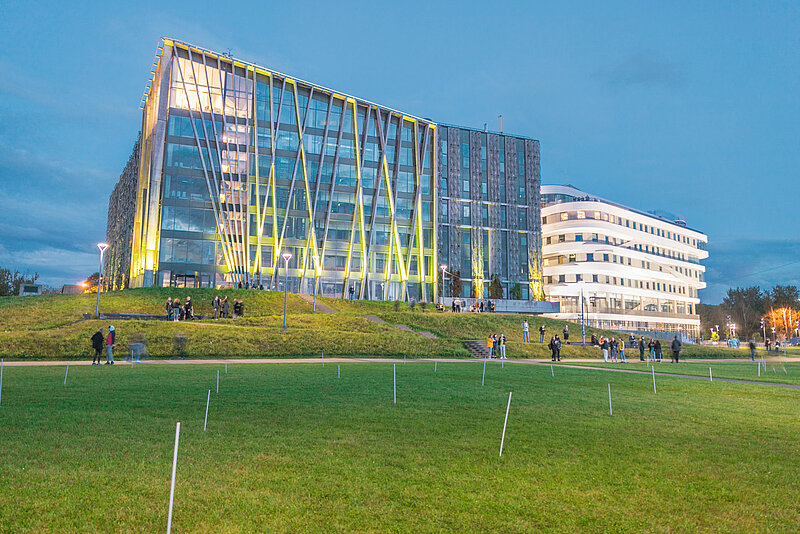
At the House of Science, Jelgavas iela 3, visitors will be able to explore how computers, AI and other technologies of the future work. They will be able to teach a computer to recognise handwriting, invent new words, try out a quantum-computer prototype and test whether it is possible to distinguish information created by a person from content generated by AI. Visitors will also be able to take part in experiments involving light, colours, human skin, UV radiation and liquids, try 3D printing, explore space and learn about satellite and asteroid observation.
In the atrium of the House of Science, the Main Science Stage will feature University of Latvia researchers – some of our brightest “science rockSTARS”. Together with the comedy group “IB draugi”, they will bring their research to life through unexpected improvisations inspired by everyday situations. Throughout the evening, science will transform into art in the Breathing Choir, the scientific and musical performance The Third Sound Phenomenon, the fusion of dance and science Microcosm in Motion, and a shared experiment with a Latvian folk song, where scientific insights will unfold through sound, movement, music and participation. European Researchers’ Night at the University of Latvia will also offer a glimpse beyond Latvia’s borders, with live broadcasts showing how researchers in Lithuania and Estonia bring science closer to the public.
At the House of Nature, Jelgavas iela 1, visitors will find an engaging programme exploring the interaction between people, nature and technology. Children will be able to try virtual reality, play “fruit pianos” and control robots, while other visitors can discover co-crystal synthesis, DNA, ancient land plants, pollinators, climate data and the sustainable blue bioeconomy. Visitors will also have the opportunity to test whether AI can identify insects and to create a postcard using wood-derived pigments. Sound artist SKANOTNE, working together with a fungi researcher, will use sensors and technology to transform plant activity and other environmental processes into a real-time soundscape.
On the Small Science Stage in the lobby of the House of Nature, authors of some of Latvia’s best student research projects will take the stage, while University of Latvia doctoral researchers will present their research through science improvisation, interwoven with performing arts.
Meanwhile, at the University of Latvia Institutes of Humanities, Kalpaka bulvāris 4, researchers’ ideas and discoveries will be transformed into music, movement, poetry and visual art. Visitors will be able to explore language, history, culture and art, take part in interactive activities, and join a discussion on the role of the social sciences and humanities in today’s world.
At Friedrich Zander’s childhood home, F. Candera iela 1, the programme will explore the interaction between AI, data, algorithms and digital culture. Visitors will be able to participate in a study on body measurements and avatar prediction using their own data and receive a personalised 3D avatar.
At the UL Institute of Solid State Physics, Ķengaraga iela 8, visitors will be treated to an exciting science show featuring colourful flames, burning foam and experiments with liquid nitrogen. They will be able to find out why helium changes the sound of the human voice, assemble a battery, take part in games and a quiz, and test their knowledge in an escape room.
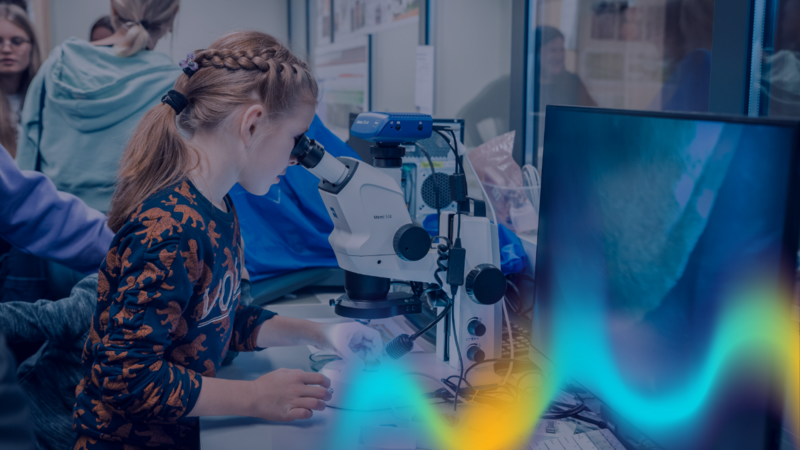
At the UL Botanical Garden, J. Šteinhauera iela 2, biology will meet folklore, literature, sound and visual art. In the Palm House, the UL School of Young Biologists will invite visitors to explore the world of bogs, while Estonian sound artist Meisterjaan will captivate audiences in the orangery with a performance that transforms cosmic radiation into sound. In the “Šķūnis” event space, biologists will interact with researchers from the UL Institute of Literature, Folklore and Art. Visitors will be able to explore the world of parasites through a microscope and learn how to protect themselves from infection. They will also be able to look for depictions of parasites in Latvian folk songs and literature, take part in memory games and reading-habits bingo, and enjoy activities for the youngest visitors.
At the Riga Photonics Centre, Šķūņu iela 4 in the Old Town, photonics and photons will be presented as one of the driving forces behind technological development in the 21st century. The programme will include demonstrations of photon interactions with beams of atoms and molecules, electromagnetic levitation experiments and the rare opportunity to “meet” photons.
At the UL Baldone Observatory in Riekstukalns, Baldone, Ķekava Municipality, visitors will be able to embark on an exciting journey through the Solar System and the starry sky. They will discover fascinating facts about the Universe and astronomy, planets, constellations and other celestial objects.
At the UL Ornithological Research Centre in Pape, Rucava Parish, South Kurzeme Municipality, visitors will be invited to discover science in nature among birds and the sounds of the night. They will be able to learn about the migration of birds, bats and insects, as well as see and try bird-ringing equipment, spotlights and an ultrasonic detector. Visitors are asked to register in advance so that researchers can arrange an opportunity to see a captured bird up close and, if conditions permit, take part in ringing it.
Registration: Oskars Keišs, 29236300; oskars.keiss@lu.lv
On 25 September, Latvia’s largest science stage will be open to everyone. This year, ERN events at UL will acquire a distinct European dimension for the first time as part of the European Commission’s “MSCA and Citizens” initiative. UL ERN is guided by the New European Bauhaus approach and the idea that science is all around us: it helps us understand the world we live in and seek solutions for the future.
A dedicated thematic area at the House of Science will highlight the European Union’s support for research and scientific development, as well as the opportunities it offers experienced and early-career researchers and scientific projects. The topic will also feature in engaging short presentations on the Small Science Stage at the House of Nature.
About MSCA and the UL Project “Aurora Nexus: Connecting People, Science & Art”
A series of science events is organised as part of the UL project “Aurora Nexus: Connecting People, Science & Art”, which is being implemented with the support of the European Commission’s “MSCA and Citizens: European Researchers’ Night and Researchers at Schools 2026–2027” programme.
The project aims to strengthen science communication, foster public interest in and engagement with research – particularly among children and young people, and promote interaction between science and art. ERN is one of the central activities of the UL project.

This text was translated using AI.
 invites everyone to its most ambitious European Researchers’ Night (ERN) to date. Activities will take place at seven addresses in Riga, as well as in Baldone and Pape. All events are free of charge. )