
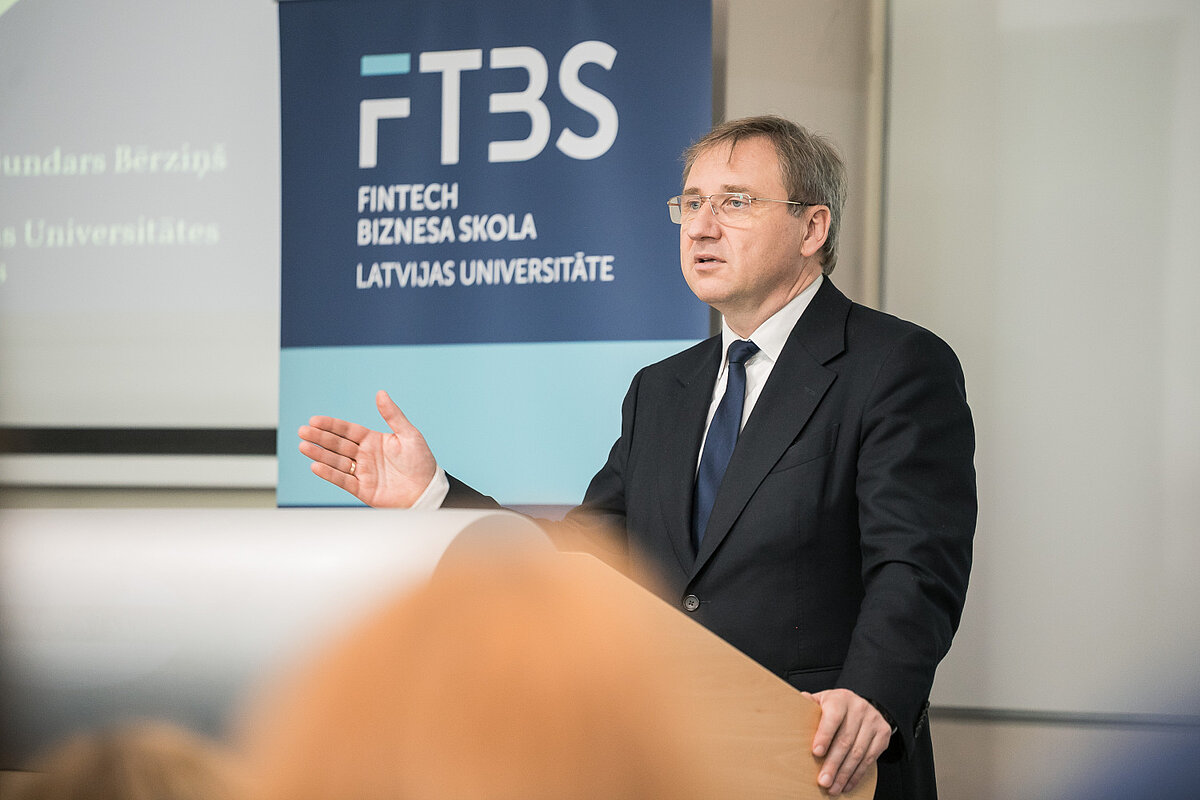
The School’s development focus is on financial technologies, digital finance, business process management, sustainable entrepreneurship and cybersecurity governance. It offers a total of 11 study programmes at short-cycle, bachelor’s and master’s levels, two of which have been developed in cooperation with a Swiss business school. In the new academic year, more than 300 aspiring FinTech specialists will study at UL FTBS. The establishment of the UL FTBS is part of Latvia’s higher education reform and the integration of the School of Business and Finance into the UL.
“The integration of the School of Business and Finance into the UL in 2025 created an opportunity to combine two strong assets – the School of Business and Finance’s experience in financial education and the UL’s academic and research excellence. We are now transforming this synergy into a new range of study opportunities. The goal of the UL FTBS is not only to strengthen financial and technology education in Latvia, but also to create a business school capable of competing internationally,” says UL Rector Professor Gundars Bērziņš.
The financial sector is increasingly being influenced by digital services, artificial intelligence, data analytics, automation and cybersecurity. As a result, the requirements placed on finance and business professionals are also changing. Financial technologies, digital finance, business process management, sustainable entrepreneurship and cybersecurity governance will be at the heart of the UL FTBS’s development.
“The brand change is the most visible part of much broader transformation – we are improving our study offering and creating an environment where finance, technology and business management are learned together. For students, this means an opportunity to develop the competences that are increasingly needed in the financial sector and in technology companies,” emphasises Inese Muzikante, Dean of the UL FTBS.
The School plans to strengthen cooperation with financial and technology companies, the public sector and other employers, involving industry representatives in the development of study content, practical studies, research and professional development.
The development of financial technologies creates both new opportunities and new risks. Therefore, knowledge of data, technology, regulation, risks and cybersecurity is becoming increasingly important.
“The development of financial technologies is increasingly blurring the boundaries between finance, technology and data. To strengthen the resilience and competitiveness of Latvia’s financial sector, we need professionals who understand not only finance, but also technology, data, risks, regulation and cybersecurity. High-quality human capital is also essential for achieving Latvia’s strategic objectives and improving the quality of compliance throughout the financial sector. At the same time, Latvia must ensure that its financial technology sector is modern and capable of keeping pace with rapid technological changes worldwide. Education must keep up with these changes,” says Marine Krasovska, Head of the Financial Technology Supervision Division at Latvijas Banka.
From the perspective of the FinTech industry, human capital is also one of the most important prerequisites for ecosystem development. Latvia’s FinTech sector has grown significantly in recent years. According to data from the FinTech Observatory published in the Latvian Startup Report 2025, 127 FinTech companies operated in Latvia in 2024, employing more than 3,600 people, while their combined turnover reached approximately €369 million. In 2024, companies in the sector paid more than €90 million in taxes. Activity in the FinTech sector continues to increase. Data from Latvijas Banka show that eight licences were issued to companies in the FinTech segment in 2025, while by August 2026, 18 new licences had already been issued.
“FinTech ecosystem growth requires not only a favourable regulatory framework, technology and investment, but also people with the appropriate knowledge. There are already more than 140 FinTech companies in Latvia, employing several thousand people, but the sector will need new professionals who understand finance, technology and business at the same time. This is why specialised education is important for the growth of Latvia’s FinTech ecosystem,” says Tīna Lūse, Head of the Fintech Latvia Association.
The mission of the UL FTBA – UL FTBS – is to develop the financial and business leaders of the future – professionals capable of combining academic knowledge with an understanding of technology, data literacy and responsible decision-making. The business school’s long-term goal is to become an internationally recognised business school with a strong FinTech profile in the Baltic Sea region.
This text was translated using AI.
The event is one of the activities implemented within the project “Internal and External Consolidation of the University of Latvia” (No. 5.2.1.1.i.0/2/24/I/CFLA/007), supported by the Recovery and Resilience Facility.
Funded by the European Union – NextGenerationEU. Views and opinions expressed are, however, those of the author(s) only and do not necessarily reflect those of the European Union or the European Commission. Neither the European Union nor the European Commission can be held responsible for them.
 School of Business and Finance will continue its work as the UL FinTech Business School (UL FTBS). Its long-term goal is to become an internationally recognised UL business school known throughout the Baltic Sea region for its strong financial technology profile and practical links with industry and research.)