

Project title in Latvian: Mehanoķīmiskās un ķīmiskās dzelzs heksacianoferrātu sintēzes optimizācija izmantošanai par radionuklīdu sorbentiem brīvā un saistītā veidā uz tekstilmateriāliem sejas aizsargmaskām
Project title in English: Optimization of mechanochemical and chemical synthesis of iron hexacyanoferrate for application as radionuclide sorbents in free form and immobilized on textile materials for face masks
Project number:lzp-2024/1-0015
Project implementer: Latvijas Universitāte (UL)
Partners of the project: Rīgas Tehniskā universitate (RTU)
Project leader: prof. Andris Actiņš
Project partner RTU representative: prof. Inga Dāboliņa
The leading structural unit of the project implementation at the University of Latvia is the Faculty of Medicine and Life Sciences
Project implementation period: 01.01.2025. – 31.12.2027.
Total budget: 300 000 EUR, including funding allocated to the LU part of the project: 153 000 EUR
Project team
University of Latvia:
- Principal investigator: prof., Dr. Chem., leading researcher Andris Actiņš, asoc.prof., Dr.Chem. Ingars Reinholds, Dr.Chem, leading researcher Artis Kons;
- Investigator: Dr. A. Grinbergs, chemist, Dr. Chem., Aldis Zekunde, expert, PhD Marija Semjonova Reinholde;
- Investigators (students): researcher, M. Chem., doctoral student Māris Bērtiņš, chemist Katerīna Novaka, senior expert Dace Ņilova.
Riga Technical university:
- Principal investigator: prof., Dr.ing., senior researcher Inga Dāboliņa, PhD, researcher Eva Lapkovska;
- Investigator: researcher Liene Siliņa;
- Investigators (students).
Abstract:
Within the framework of the project, new theoretical and practical insights will be created, on the basis of which materials and means will be developed for anti-radiation protection of civilians and professional service personnel. The newly created knowledge will contribute to the preparedness of the state and society for defense in case of nuclear incidents and nuclear war. The research will include the following sections: iron hexacyanoferrate synthesis based on theoretical calculations and experimental optimization, using two parallel or combined strategies - mechanochemical and liquid synthesis at LU, and in collaboration with experts from RTU - optimisiation of the encoring the active substance to suitable textile fabric, evaluation of cesium sorption-desorption mechanisms, and adjustment of materials to the user.
Project outcomes:
Type of result | Amount |
| Orignal scietific articles published, submitted or accepted for publication in the Q1 or Q2 quartile publications included in Web of Science Core Collection or SCOPUS databases | 3 |
| Scientific databases and datasets developed within the project and prepared according to FAIR principles | 3 |
| Intellectual property registered in Latvia (patents, design rights, topographies of semiconductor products, plant breeders' certificates, additional protection certificates for medical products or other products) | 1 |
| Submitted project proposal in an international research and development project competition (competition abroad or submitted by an international consortium) | 1 |
| Submitted project proposal in the Latvian research and development project competition |
1 |
PROJECT ACHIEVEMENTS:
The project is implemented in four work packages (WP – from the English “work packages”), where WP1-WP3 are coordinated by the University of Latvia in cooperation with RTU and WP4 will be coordinated by RTU:
- WP1 “Project management and dissemination” (month 1-36 of the project);
- WP2 “PZ synthesis” (month 1-15 of the project);
- WP3 “Textile mask prototype” (month 16-25 of the project);
- WP4 “PB-textile ergonomics and service life adjustment” (month 22-36 of the project).
The reporting period covers the first quarter of the project, during which the project implementation was initiated, the goals and objectives of the work packages were defined, as well as the initial planning and preparation phase of the activities were carried out. The activities were organized according to the project schedule.
During the reporting period, activities were carried out within the framework of work packages WP1 and WP2, which are described below.
WP1 “Project management and dissemination” activities.
Within the framework of the WP1 activity, the project manager, together with the project manager of the cooperation partner institution and WP1 responsible I. Reinhold, have carried out activities to ensure the successful implementation of the project.
The implementation of activity 1.1 of the project WP1 has begun, a contract has been concluded for the project, the first funding has been received and the project manager has started to carry out administrative activities with the project team, including RTU cooperation partners, for the implementation of the project and the acquisition of funding.
In the first quarter of the project, a remote meeting of the institutions of both project partners was organized, which was recorded (deliverable D 1.4). The organization of project action committee meetings was discussed between the project partners. The activities completed in the first stage and the activities to be carried out in the second quarter have been discussed.
1.2. activities within the framework of "Public information" are as follows:
- Information about the implementation of the project has been prepared on the website of the project's lead partner: https://www.lu.lv/zinatne/programmas-un-projekti/nacionalas-programmas-un-projekti/2024-gada-1-konkurss/mehanokimiskas-un-kimiskas-dzelzs-heksacianoferratu-sintezes-optimizacija-izmantosanai-par-radionuklidu-sorbentiem-briva-un-saistita-veida-uz-tekstilmaterialiem-sejas-aizsargmaskam/#c162313.
- A reference to the project activities has been created on the ResearchGate website in the profile of the project's main executor, Ingaras Reinholds (the section on ResearchGate that allows for a separate section to be attributed to the project, which was promised in the project application, has been removed).
Within the framework of Activity 1.4, a data management plan (DPP) “FLPP2024: Prussian Blue-Modified Fiber Materials: Synthesis and Applications” (in English) has been prepared, which is published in the project's NZDIS (LZP) module: https://argos.openaire.eu/explore-plans/overview/public/123c3a0c-2261-4678-9fc1-450a58880391
The project plan envisages the preparation of at least three scientific databases on the project results – two scientific databases on WP2 and WP3 activities will be prepared by the mid-term of the project and another scientific database, which will be prepared by the project partner institution RTU on WP4 activities, will be prepared on the basis of the project final stage. The scientific databases obtained in the project are planned to be published in an openly accessible form, mainly in the European open research repository Zenodo, ensuring compliance with the FAIR data principles.
WP2 “Prussian Blue Synthesis” activities.
Within the framework of activity 2.1., the pre-synthesis of Prussian Blue (PZ) was carried out using chemical and mechanochemical methods, using different molar ratios of iron II or III chloride and red/yellow blood salt reagents (3:4, 1:1, 4:3 and 3:2) to obtain potential color pigments for further fabric dyeing, for which the structure characterization has begun using spectrometry (infrared and Raman spectrometry), X-ray diffractometry (XRD) and X-ray fluorescence analysis (XRF) methods. The use of these compounds in fabric dyeing, depending on the sorbents' caesium sorption capacity from aqueous solutions, is planned to be evaluated in the next stages of the project.
Within the framework of activity 2.2., preliminary fabric dyeing tests were carried out. Four fabric samples received from RTU cooperation partners were selected for LU research – two different TENCEL fabrics with different properties and two different Lyocell materials, all of which have been used in the development of various layer materials for face masks. The structure of the fabrics was analyzed using the FTIR spectroscopy method.
To test the effect of fabric pretreatment on dyeing efficiency, one of the Tencel fabrics (17/0672/4723) was used.
Initially, pretreatment methods were evaluated, only several samples were prepared and treated in 5 different ways (by performing weak oxidative treatment with peroxide, oxidative treatment with persulfate, alcohol solution and alkaline solution at room temperature and elevated temperature), evaluating the changes in the cellulose surface and the effect of PZ dye stabilization.
Based on the feasibility study of the project manager, 8 different dyeing methods were selected for the pre-modified samples, using different ratios of salt solutions, each of the methods using all 5 pre-treatment types (total number of samples 40 samples with different compositions).
After treatment, visual observation was performed, as well as elemental analysis by XRF in a helium atmosphere with a mask diameter of 8mm. The iron content in Tencel fabric samples dyed with Prussian blue was assessed. It was determined that samples that visually showed uniform fabric coloration had a higher iron concentration on the fabric fibers.
Cesium sorption is a prerequisite for the suitability of PZ-dyed fabrics. Therefore, cesium sorption was determined from aqueous solutions using samples with the best surface coloration and different iron content for tests, and stable cesium chloride salt solutions (Cs+ mass concentration 50 μg/L) for experiments, sorption being carried out for 1 h.
Assuming initially that cesium sorption may be proportional to the mass concentration of Prussian blue, which is represented by a certain mass concentration of iron, an attempt was made to find equations that describe the dependence of sorption on iron. Experimentally, it was determined that this relationship is described by the equation
q=q0+(1-e-k[Fe]), as well as the Langmuir-type equation q=q0*kc/(1-kc), where q is the amount of Cs+ ions in micrograms per weight of fabric containing PZ.
At the same time, it was determined that this relationship shows 4-6 clusters that characterize changes in cesium sorption, depending on the iron content in the dyed fabrics and the chosen Prussian blue synthesis method in the dyeing process.
Additional structural studies should be performed in order to evaluate the cluster-forming factors, because the results showed that even at high iron content, cesium sorption efficiency can vary.
Based on the results obtained, dyeing of a second Tencel fabric has begun.
In the next project period, the comparison of Tencel samples will be continued, assessing cesium sorption, as well as a more in-depth assessment of fiber dyeing, using spectroscopy and microscopy methods to characterize the structure. The synthesis methods of the selected pigments will also be further evaluated.
The next stage of experiments has been discussed with the RTU cooperation partner, which will include testing the color stability of the prepared samples using spectrophotometry and color characterization according to the CIELAB three-dimensional color system, as well as performing air permeability measurements of the samples, evaluating differently dyed samples.
The main activities took place within WP1 "Project Management and Dissemination" and WP2 "PB Synthesis", which are described in detail below.
WP1: Project Management and Dissemination Activities.
As part of the WP1 activity, a remote meeting of the two project partner institutions was organized in June of the 2nd quarter of the project, which has been recorded (deliverable D 1.4). The following issues were discussed during the meeting:
- The UL research team reported progress on WP2, including the continued improvement of Prussian Blue (PB) pigment binding methods to cellulose fabrics during the first reporting period.
- The RTU team presented the prepared plan and standardized test methods for evaluating medical textiles and filtering mask materials, including further experimental plans and test sample selection methods.
- RTU researchers also reviewed decolorization tests conducted during the period on fabrics coated with PB produced by UL. They concluded that under harsh washing conditions, PB could be removed from the fabric, although reference fabrics were not stained — suggesting a need to optimize the dyeing method if reusable materials are planned. However, the project’s primary aim remains focused on single-use protective face masks in radioactive contamination scenarios.
- Dissemination activities were discussed, including participation in international conferences in 2026, particularly the International Federation of Associations of Textile Chemists and Colourists competition to be held in Barcelona, Spain, in Autumn 2026.
WP2 “PB Synthesis” activities.
This reporting period covers Q2, during which the following scientific activities were carried out by the UL research team in cooperation with RTU, continuing previous studies:
Pre-treatment evaluation. The use of ammonium persulfate for fabric pre-treatment prior to PB coating was tested in more detail. Results showed that this method did not yield the desired uniform PB coverage, with low iron content detected on the fabric (0.46–1.79% depending on method), as determined by XRF analysis. Ideally, Fe content should be ≥2%.
Fabric dyeing with PB pigment dispersions. As planned, the efficiency of dyeing using a pre-synthesized PB suspension was evaluated at room temperature (22.4 °C). Tests were conducted on Tencel 17/0672/4823 fabric using two types of PB pigments synthesized by combining K₄[Fe(CN)₆] and FeCl₃ in molar ratios 4:3 and 3:4, to assess how solubility affects fabric binding. Experiments varied reagent addition sequences, pigment aging time (1 h, 2 days), and modification temperatures (room vs elevated).It was concluded that the modification method requires improvement, as the PB layer was easily washed off with distilled water and showed uneven coverage. Fe content was not measured due to visual evidence of poor binding. New approaches for improved PB binding will be tested in the next project period.
Iron content vs Cs⁺ sorption correlation. Continuing earlier efforts, the relationship between XRF-determined Fe content on fabric and Cs⁺ ion sorption was evaluated. The data showed a logarithmic correlation, from which sorption capacity and equilibrium constants were calculated.
Sorption isotherm studies. One full sorption isotherm was obtained experimentally, and both capacity and equilibrium constant were calculated. The constant values differed significantly from previous two-point estimates. The isotherm could be described by the Langmuir equation, but better fit was obtained using the BET equation, which will be further justified in future project stages.
Cs⁺ sorption/desorption kinetics. Sorption kinetics at 22°C were measured and approximate rate constants were determined for both sorption and desorption. Kinetic equations for sorption (q–t) were derived and compared with published θ–t relationships (filling degree vs time). Desorption studies were performed to assess the practical usability of PB-coated fabrics. Fabrics with Fe content >3% were selected. Desorption kinetics were derived, and equilibrium measurements were conducted.
A report was prepared on the characterization of synthesized PB compounds and their physical properties (Deliverable D2.1).This report will be submitted to the ZENODO repository as a restricted-access document and will be made available upon request.
Further studies at different temperatures are planned for the next research period.
During the reporting period, the main activities were carried out within Work Package WP1 “Project Management and Dissemination” and WP2 “Prussian Blue Synthesis”, as described below.
WP1 “Project Management and Dissemination” Activities
On 26 September 2025, within the framework of the European Researchers’ Night, researchers from the University of Latvia (UL) and Riga Technical University (RTU) presented poster sessions and demonstrations on various Prussian Blue synthesis methods and project-related activities.
The exhibition stand attracted considerable public interest and was also presented in a more focused setting to representatives from the industry and scientific community. The discussion at the stand was led by Professor, UL Rector Gundars Bērziņš, who gathered experts and visitors for an exchange of ideas.
The project’s principal investigator, Ingars Reinholds, provided an overview of the team’s achievements and future objectives within this and other ongoing UL projects. It was emphasized that the developed prototypes have potential for dual-use applications, with further refinement planned within the project’s framework, leading toward subsequent research and innovation initiatives.
(A) (B) (C)
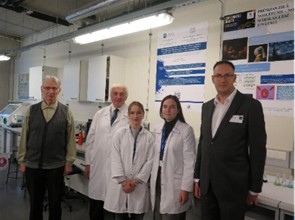
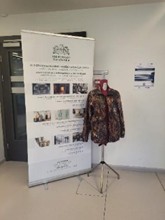
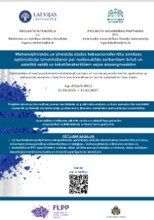
UL (A) and RTU (B) research group stands at Researchers’ Night 2025, and the project stand (C).
WP2 “Prussian Blue Synthesis” Activities
The reporting period covers the third quarter of the project, during which the research team of the University of Latvia, in collaboration with RTU researchers, continued and expanded the activities initiated in the previous phase.
Within this period, the optimization of Prussian Blue synthesis processes was carried out, applying several approaches — standardized laboratory protocols, patented methods, and newly developed modified techniques — aiming to improve iron complex formation and its fixation on the textile substrate.
The optimal reaction conditions and process steps were determined by varying reagent molarity, oxidizing environment (H₂O₂ presence), ultrasonic treatment duration and repetition, and by adding a stabilizing additive (polyvinylpyrrolidone). All syntheses were performed in aqueous media under identical substrate size, temperature, and drying conditions to ensure reproducibility.
Five samples with different processing conditions were prepared for analysis. The obtained results showed significant differences in iron content, reflecting the amount of Prussian Blue complex formed on the textile surface. The highest iron content (5.47%) was achieved using a modified patented method, in which a mixture of FeCl₃ and K₃[Fe(CN)₆] solutions was applied together with oxidative treatment by H₂O₂ and ultrasonic processing cycles. This approach enabled a more efficient formation of the Prussian Blue complex on the fiber surface.
The results confirmed that modified synthesis methods provide a significantly higher degree of iron fixation on textile substrates. The most effective method combined simultaneous Fe(III) and [Fe(CN)₆]³⁻ complex formation with hydrogen peroxide oxidation and ultrasonic treatment, resulting in up to a fivefold increase in iron content compared with standard procedures.
Overall, these tests demonstrated that optimization of synthesis parameters and process sequence significantly affects the final product’s composition and quality, creating a strong foundation for producing more efficient Prussian Blue nanostructures for further experimental studies.
Following the optimized synthesis method, where the textile fiber was treated with a K₃[Fe(CN)₆] and FeCl₃ mixture followed by H₂O₂ oxidation, a Prussian Blue coating with approximately 4.7% iron content (determined by XRF) was obtained. These modified fabrics were then used in cesium ion (Cs⁺) sorption studies, simulating the binding of radioactive cesium.
Experiments were conducted at two temperatures (4 °C and 23 °C) and two stirring rates (80 and 300 rpm) to determine sorption kinetics and temperature dependence. The results were interpreted using Langmuir isotherm and exponential kinetic models, revealing that sorption efficiency increases markedly with higher stirring rates and temperatures.
Thus, this phase of work yielded practically validated data on Cs⁺ ion binding rate and capacity on Prussian Blue-coated textile materials, confirming their potential for radiological decontamination and protective material development applications.
Prepared by:
Ingars Reinholds
During the final quarter of the first project year, the activities initiated and implemented in the 3rd reporting period were continued. An additional micromodal viscose fabric (No. 17/0672/4867, RTU) was received from the RTU project partner and used during the reporting period. The fabric was coated with Prussian blue (PB) using the previously applied method, involving treatment with iron(III) hloride and potassium hexacyanoferrate(III) solutions in the presence of hydrogen peroxide. In total, four fabric samples were prepared. After synthesis, the samples were treated in an ultrasonic bath in order to remove PB particles not bound to the fabric surface, following the sample treatment procedure developed during the third reporting period.
The PB-coated fabric samples exhibited a characteristic dark blue coloration. Using X-ray fluorescence spectroscopy (XRF), a reproducible iron content of approximately 2.0% was determined, confirming the stability of PB coating formation and the reproducibility of the selected synthesis method.
Cs⁺ sorption kinetics studies were carried out for the samples at 4 °C and 23 °C using a stable cesium Cs-133 solution (50 mg/L) at a stirring speed of 300 rpm. The experimental data were analysed using the Langmuir kinetic model and an exponential equation, allowing evaluation of the kinetic parameters of the sorption process. It was determined that increasing the temperature from 4 °C to 23 °C results in an approximately 1.5-fold increase in the reaction rate constant, while the sorption capacity remains essentially unchanged and, depending on the applied model, is temperature-independent, remaining in the range of approximately 3.6–4.0 mg/g. The obtained results indicate a thermally activated sorption process and confirm the potential of PB-modified textile materials for the immobilised binding of Cs⁺ ions.
Based on the analysis of sorption results and the visually observed non-uniformity of the PB coating in samples from previous reporting periods, it was concluded that cellulose fibre functionalisation is required to improve pigment binding. Literature analysis identified cellulose oxidation using potassium periodate (KIO₄) as a promising approach to promote hydroxyl group oxidation. According to the literature, oxidation of vicinal C2–C3 hydroxyl groups in cellulose leads to the formation of dialdehyde groups, which may improve PB binding to the fibres.
Within the reporting period, two cellulose pre-treatment methods using KIO₄ were initiated in order to increase fibre surface reactivity and improve PB adhesion:
treatment of the fabric in a saturated KIO₄ solution at room temperature and at 50 °C, followed by treatment in a glycerol solution and rinsing;
treatment of the fabric in an acetic acid–acetate buffer using different KIO₄ concentrations and exposure times (15 min–2.5 h).
The functionalised fibres were subsequently coated with PB using the method applied at the beginning of the reporting period. As a result, samples with visually more uniform coloration were obtained. In the next reporting period, Cs⁺ sorption tests of the functionalised samples are planned, along with detailed analysis of structural and surface parameters, including evaluation of iodine and iron content and other relevant characteristics.
During the reporting period, the obtained research results were analysed, and in accordance with the project performance indicator plan, a scientific data set on the research results was prepared in line with the planned indicators of WP1 (preparation of the first scientific data set by month 15 of the project). The scientific data set has been deposited in accordance with the developed project data management plan.
In parallel, work on the preparation of a scientific publication has been initiated, compiling and systematising the results obtained during the first year of the project.
Prepared by:
Ingars Reinholds