
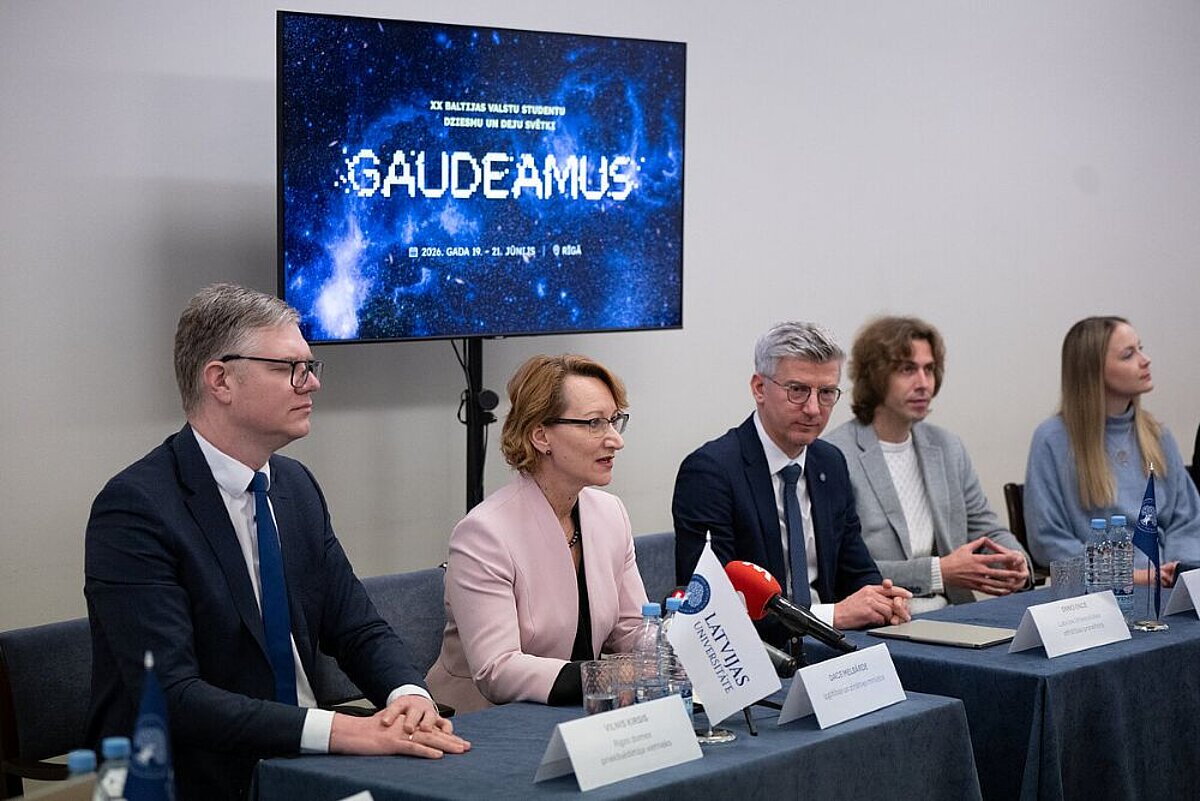
The XX Baltic Student Song and Dance Festival in Riga will convene student collectives of Baltic higher education institutions with participation of 66 choirs, 44 folk dance ensembles, and 9 wind orchestras.
Minister of Education and Science Dace Melbārde emphasizes: “Gaudeamus is a unique tradition that began in 1956 in Tartu, and since then, taking place for 19 times, – alternately in Latvia, Lithuania and Estonia – has affirmed the unity and creative power of Baltic students. It is not just a cultural event – the festival represents a value that strengthens our academic community and, at the same time, the solidarity of our region. We frequently call upon cooperation in education and science, joint research projects and academic mobility. However, this celebration reminds us that cooperation also has a cultural dimension. It is an opportunity for students from Latvia, Lithuania and Estonia to meet not only in auditoriums and laboratories, but also in the united choir, on the dance floor and on the grand stage of the festival.”
The preparation for the celebration is ensured by UL, coordinating the participation and preparatory process of the music and dance collectives from Baltic higher education institutions, the implementation of the celebration programme, as well as organizing the celebration events. “We regard the right to organize Gaudeamus as a great distinction and confirmation that the University of Latvia is a reliable partner and a capable organizer of an international event of this scale. We are mindful of the responsibility it carries, and will readily invest our experience, infrastructure and, most importantly, people’s enthusiasm to ensure that these celebrations are professionally organized, inspiring and truly unifying,” emphasizes Enno Ence, UL Vice-Rector for Development.
The city of Riga is an important strategic partner of the festival. The city’s deputy mayor Vilnis Ķirsis confirms: “Riga has proven that it knows how to organize festivities, therefore, we are pleased that the city will become the student capital of the Baltic states this summer. Gaudeamus, in my opinion, is a beautiful gift to Riga on its 825th birthday, which we will celebrate this year with great enthusiasm, and the Baltic Student Song and Dance Festival will be one of the major summer events in Riga. The city is ready to provide all the required support to make the festival a success for both participants and visitors.”
The artistic team in charge of staging of Gaudeamus 2026 works in close collaboration with the director and author of the artistic concept of the festival Juris Jonelis, the artistic director of the choir programme Edgars Vītols, the artistic director of the dance programme Dagmāra Bārbale and the artistic director of the wind orchestra programme Māris Martinsons. Juris Jonelis says: “The festival programme reflects the perseverance, vigorous spirit and dedication of the students, which is an endless dose of energy. The XX Baltic Student Song and Dance Festival is an inspiring process that unites eternal cultural values with a future vision of man’s place in the world. Traditions are not only preserved, but also transformed and adapted to contemporary understanding, creating a synergy shared between science, art and the human soul.”
The envisaged festival programme is diverse and extensive – on 19 June, a folk music and dance programme will unfold at Dome Square in the atmosphere of the annual Grass Market held in preparation to Midsummer celebrations, at 17:00 the opening concert of the festival will be held in the Great Hall of the University of Latvia, at 20:00 a concert of folk dance ensembles will reverberate through the Dailes Theatre. On 20 June, at 11:00, wind orchestras will perform in Vērmanes Garden, while at 20:00 a concert of sacred music is to take place in the Dome Cathedral. On the final day of the festival, 21 June, at 16:00, festival participants will march from the Riga Old Town to Brīvības Square, where the grand concert “To Infinity...”– “Līdz bezgalībai” – will commence at 17:00.
Admission to the open-air concerts of the festival is free. Admission to the concerts at the Dailes Theatre and the Great Hall of the University of Latvia is provided at no cost, with free entrance tickets. Information on receiving free entrance tickets will follow.
About the festival:
The Gaudeamus tradition began in 1956 in Tartu and since then the festival has been held in the Baltics 19 times. It is a meaningful part of the Baltic cultural and academic identity, promoting the preservation of traditions and the involvement of young people in folk culture. It is an important stage in preserving the unique tradition of the Song and Dance Festival and strengthening the unity of the Baltic states. The festival takes place alternately in one of the Baltic states. The organization of the festival is ensured by the Ministry of Education and Science in cooperation with the University of Latvia and the Riga Municipality.
, Vērmanes Garden, Dailes Theatre, Dome Cathedral, Old Riga and Brīvības Square.)