
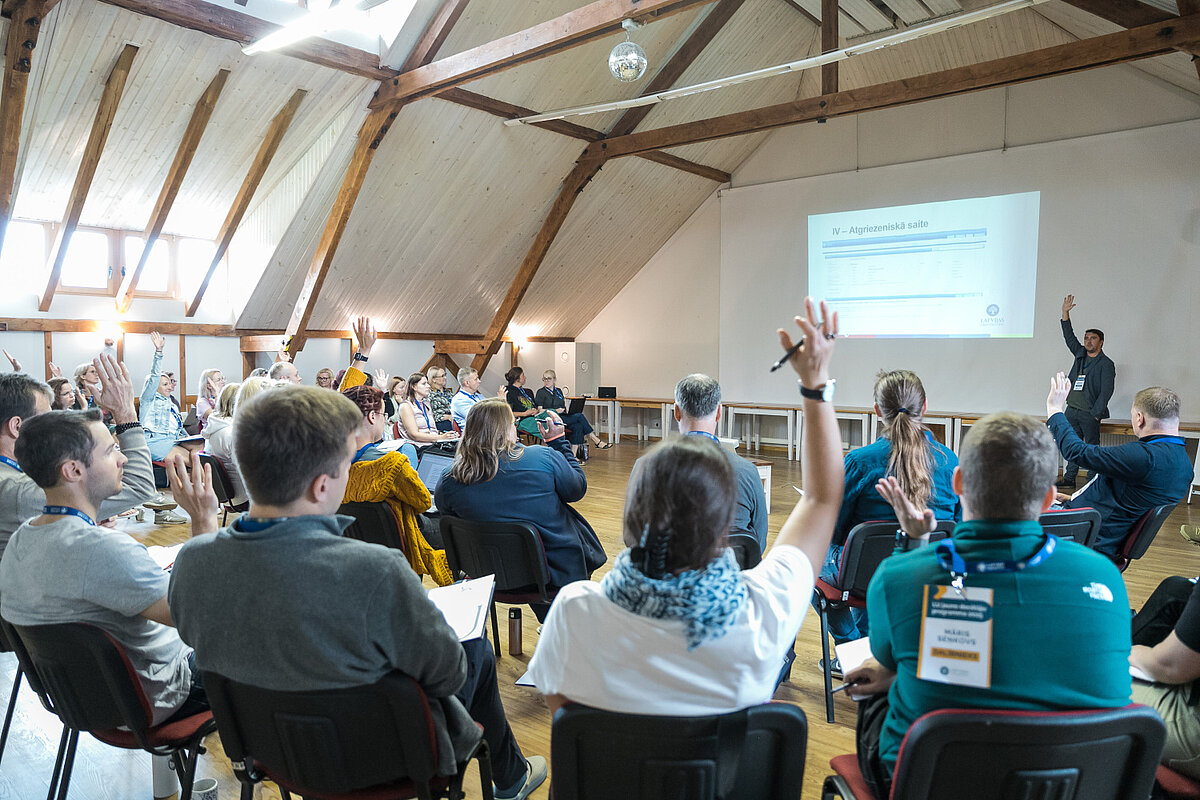
According to researcher Agnese Lastovska, the head of the first UL Young Lecturer Programme, this measure strengthened the belief that in all the represented fields of science and academic achievements, UL lecturers are inquisitive, ready for knowledge and open to improving their pedagogical practice. “In addition to deepening fundamental pedagogical knowledge, our goal was to take into consideration the modern trends and innovations, for example, the use of artificial intelligence tools in the learning process and the improvement of lecturers’ professional efforts,” says A. Lastovska.
The topics mastered by the participants included the role of a modern lecturer, the basic principles of a student-centred approach, the characteristics of modern students and generations, the basic structure and design of a study course, the importance of cross-curricular competencies in a lecturer’s work, feedback, collaboration, reflection, and others.
“The programme was truly saturated with the latest theoretical insights, as well as practical, methodological techniques, providing significant support in the daily work of a lecturer, which is further confirmed by the positive feedback from the participants,” says Gunta Kalvāne, leading expert at the UL Doctoral School. “We frequently gain our first teaching experience during doctoral studies, therefore it was a great responsibility and pleasure to participate in the organization process.”
“The Young Lecturer Programme offered a remarkably positive and supportive atmosphere, which gave me the opportunity to improve my professional skills, and, furthermore, to meet colleagues from other faculties and feel like part of the wider academic community. Being physically away from the environment of everyday work and responsibilities was a great benefit – it enabled me to fully focus on evaluating my teaching work and reflecting on my experience. At the end of the course, I left with clear ideas and definite steps that I will implement and improve in my teaching work in the future,” thus, the studies were described by Iveta Ozola-Cīrule, a researcher at the Faculty of Education Sciences and Psychology. Meanwhile, Marika Briede, a doctoral student at the Faculty of Medicine and Life Sciences, says: “A different horizon opened up for me – when you cast your sights further, you realize that there is still more, and beyond that – much more!”
The following lecturers and experts were involved in teaching of the programme participants: Prof. Zanda Rubene, researcher Mārtiņš Priedols, student coordinator Anete Sapne, Prof. Gunta Krūmiņa, Assoc. Prof. Sanita Baranova, leading researcher Gunta Kalvāne, Prof. Ieva Margeviča-Grinberga, Assist. Prof. Daiga Kalniņa, lecturer Ilva Cinīte, Assoc. Prof. Guntars Kitenbergs, Assoc. Prof. Gunita Deksne, as well as tenured Assoc. Prof. Sanita Reinsone.
Although the 2025 programme has concluded, its participants continue active collaboration – meeting in seminars, analysing scientific articles, discussing key theses and sharing practical insights. This experience helps to create a culture of shared learning in the UL academic environment.
It has been envisaged that the next UL Young Lecturer Programme will take place shortly before the start of the autumn semester of 2026. The Pedagogical Development Unit of UL Study Department will announce the competition for prospective participants in the spring of 2026.
 continues to advance its academic potential by purposefully investing in the professional development of its lecturers. This autumn, the first 40 participants who successfully passed the competition and participated in the young lecturers programme, received their certificates of professional development. Prospectively, such training is to be organized once a year and is part of the future pedagogical growth support system.)