
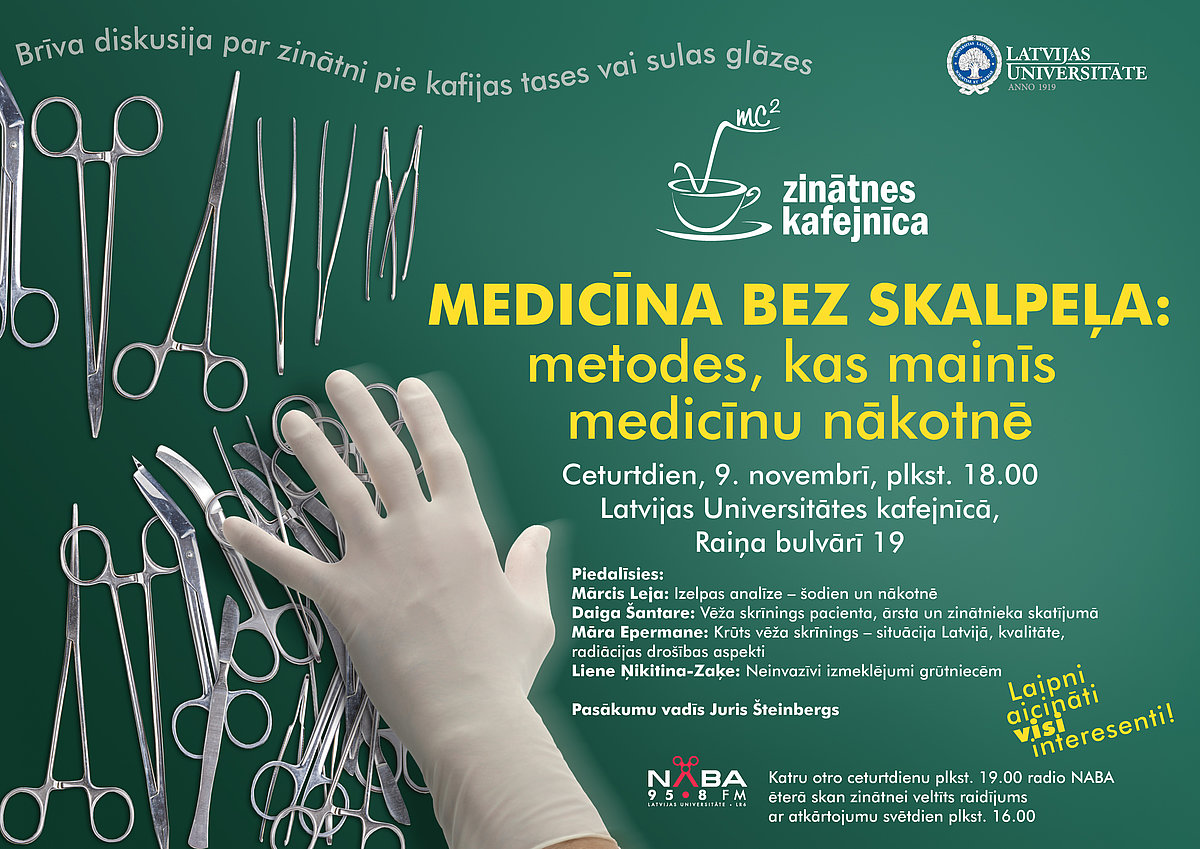
Lately, among the global priorities a significant place is taken by the so-called personalized medicine, which opens new doors for the diagnosis and cure of many diseases. “Medicine without scalpel” designates non‑invasive methods in medicine, especially focusing on those concerning cancer screening or simple non-invasive tests for other purposes.
Both in European Union and Latvia organized screening has been recommended to decrease the mortality rate, which is escalated by three predominant types of cancer. The breast cancer screening is implemented with mammography (radiographic method), the cervical cancer screening is carried out, using gynaecological swab, and the intestinal cancer screening – faecal occult blood test method. Many European experts agree that in preventing the lethal outcome in various cases of tumour the screening is essential, However, there are too few effective tumour detection methods.
Additionally, the past years have brought discussion of the benefits and possible risks possibly related to screening tests. These perspectives will form the basis of Science Cafe discussion about screening tests in Latvia, their quality, and the evaluation of the mammography screening method from the safety aspect regarding radiation. The following experts will share their research results and knowledge:
- Mārcis Leja, Director of UL Institute of Clinical and Preventive Medicine, UL Professor, will provide an insight into a non-invasive method of exhaled breath analysis;
- Daiga Šantare, Leading Researcher of UL Institute of Clinical and Preventive Medicine will talk about the cancer screening from the viewpoints of patient, doctor and scientist;
- Māra Epermane, Head of Diagnostic Radiology Centre will provide information about the breast cancer screening in Latvia, its quality and safety measures dealing with radiation;
- Liene Ņikitina-Zaķe, Molecular Biologist at GenEra laboratory will talk about the non-invasive tests during pregnancy that help to reveal the gender of the foetus and the Rhesus factor, which, in some cases, can be extremely important.
 after a long break, the Science Cafe will resume conversations and discussions. The topic of the upcoming event is “Medicine without scalpel: methods that will change the future of medicine”.)