
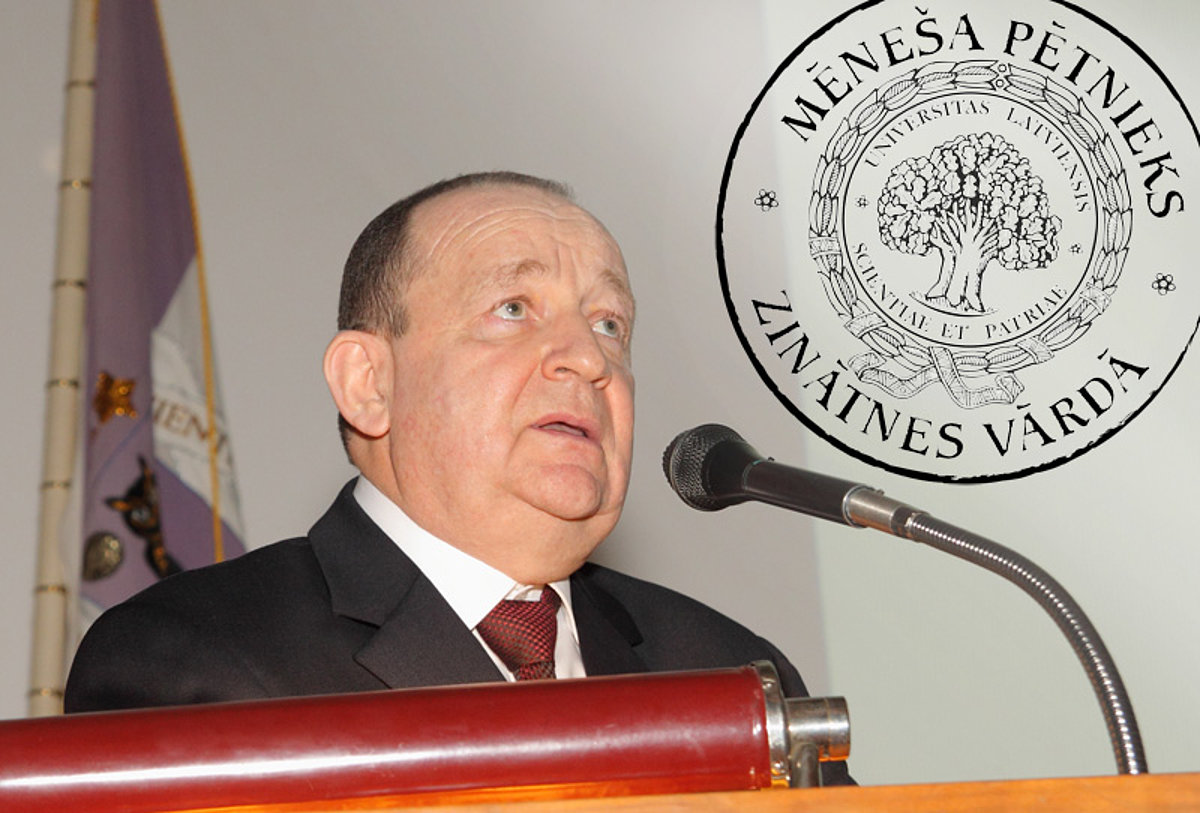
The professor is also the founder and director of the UL Centre for Judaic Studies. His scientific merits have been recognized by the UL Annual Award in February 2010.
Who do you identify yourself as – a teacher, a scientist or a researcher?
I am a professor of the University of Latvia, therefore my job is of a double nature. I am a teacher and a scientist. It is completely impossible to be a teacher one day and do research and scientific work the next one. However, one could think and reason like a teacher at one moment and like a researcher at another one. This is the difference and advantage of the academic corpus of any university in the world that has achieved a certain level of stability and scientific capacity, and it does not only concern professors, but also lecturers, docents, associated professors and scientists. If a researcher is not a professor and doesn‘t teach, or vice versa – a professor conducts no research work, that, to my mind, is not right. In the West, at the universities of Europe and America a professor is always associated with a research group and particular scientific achievements. On the other hand, a professor always undoubtedly works with his or her students and junior scientists, who have just received their doctoral degree and immediately joined a project.
Generally speaking, it's hard to tell whether I am a teacher or a scientist. I’d say – a teacher-scientist, because these two professions have completely bonded in me and become a part of my daily life.
In the previous year you have published a whole fourteen scientific articles, which is quite a lot! How did you manage it?
It’s simple: publications are not made by a single person. I have good colleagues and we cooperate perfectly well, we work in groups and learn from one another. Academic work is very creative and at the same time it demands accuracy. It might sound strange, but in this sense my work could be compared to that of an actor, who learns their parts and rehearses for many hours. Even their work includes a lot of routine. Similarly it is with research work. It often takes months and even years to create a good article. It’s nice that the work can be split up: there are colleagues, who like making measurements but don’t like writing, and there are those, who are good at writing but don't take part in experiments. There are theoreticians, who can calculate very fast and accurately, and those, who don’t like calculating. And all the activities are always surrounded by ideas – what to do, which direction to go next. For everyone involved it is always something original, fresh, interesting, important and necessary.
What concerns the quantitative index of the scientific publications, it is not of a big importance. I have the honour of representing the Latvian Physical Society in the Consultative Council of the European Physical Journals. There, regular discussions are held about how the scientific success and excellence should be measured. Of course, it is important, how many articles one has published, how many authors an article has, in which journals it has been published, how much an author or an article has been cited, and each of these criteria has its own pluses and minuses. There are journals, which accept all scientifically correct publications, so it is not very difficult to get published in them; however, some titles are more selective and choose articles based on their originality, importance and relevance. Even though the number of publications is not among our priorities, I always have a feeling that we could do more and better and there are many ideas that we could implement.
How do you evaluate the general working conditions at the University and Laser Centre?
Speaking about the UL Physics and Mathematics Faculty, I can say that I am very happy with the favourable working conditions that have been created here. We have our own building and territory, a block for lectures and a block for laboratories, as well as dormitories – all in perfect condition, compact and located within easy reach. Not only does it significantly facilitate my work, but it also has a positive effect on the students – it helps create an appropriate social environment with its own customs and activities. There are, of course, many other institutions, with which we must cooperate and coordinate our actions, in which our professors work in parallel with us, but it is important that there exists such a centre, where not only lectures, but also practical and scientific work takes place, the corresponding studies in the laser laboratories are conducted, etc.
How would you evaluate the students’ interest in the capabilities that the Laser Centre provides? What are their chances of getting involved in the scientific research and work in the laboratory environment?
It must be admitted that students are very interested and, undoubtedly, take an active part in such work. A great number of students have always been involved in various projects. Although their contributions should be evaluated at the student level, it must be pointed out that a certain interest in the research work emerges as early as at the bachelor’s study level. Many join us at the master’s study level, but the most active part are the doctoral students, because most of them do their own research, which often implies using the laboratory equipment. Generally, they are a very active scientific driving force. Often it starts with a correct choice of the bachelor thesis and active work in a postgraduate program, which results in highly qualified and motivated students with an appropriate scientific constituent, who take part in projects with appropriate project leaders and work as scientists. For example, doctoral students conduct research every day, it is their daily work. We, on our part, make our best to provide them with pedagogical experience as well by encouraging them to work in class with the bachelor students and act as advisors for bachelor theses.
Please, tell about the structure of the Laser Centre. What is it designed for?
This Centre is designed to provide a possibility to work and study. It provides both the possibility of using the equipment and an appropriate remuneration. It is a kind of scientific school at a level that allows achieving such results, which would be internationally available and recognized, as well as could be published in leading scientific journals, such as Physical Review, Journal of Chemical Physics, European Physical Journal and others. If we manage to reach that level, our students will see that one can do important scientific work here as well. Of course, it is motivating: such a publication would mean an international recognition in the most direct sense, because these journals determine the pace of scientific progress, they are the main trumpets of science by definition. And if one’s article has been accepted, it means that they are at one level with the best schools in the world.
Therefore I pay close attention to the participation in international scientific conferences and also encourage my students to take part in them: it’s very important to have a personal experience of going there, listening to others and taking part in discussions, because it brings the attention to and makes others notice one’s personal achievements. Such conferences take place quite often and are also organized here in Riga. There is a young scientists’ conference, the Scientific Conference of the University of Latvia, and it takes place once a year. During the conference students present their achievements and this process is of great importance, because one must learn to correctly present their achievements and speak in front of the audience about their progress and daily work, which makes the scientific constituent I mentioned earlier.
How is the international cooperation being developed?
For example, currently we are cooperating very closely with Berlin University of Applied Sciences for Engineering and Economy, Lomonosov Moscow State University, University of Hannover, University of California, Berkeley, and other universities. We also perform joint tasks. For example, we are studying atoms, which are important for astrophysics, here on-site together with scientists from Berlin and Istanbul. The experiments are going on in Riga, because the UL Laser Centre has all the required equipment. As a result, we create joint publications.
Is there any scientific cooperation at the national level as well?
My closest cooperation is with Professor Mārcis Auziņš, who is the head of one of four Laser Centre laboratories. We are conducting a study, which consists in exciting atoms with a high-quality, accurate, controlled laser beam and observe the effects occurring in the external fields. Professor Auziņš together with his students has developed a theory to accurately describe these effects. It is a team work of two laboratories, which aim is to develop a more accurate and convenient method of measuring the magnetic field. This topic is highly relevant and many students have joined the project.
What are your main current directions of research?
I have the honour of leading the Molecule Optical Polarisation Laboratory, in which we are currently actively studying diatomic molecules of alkali metals. In a way they are similar to hydrogen molecules but are formed of atoms of sodium, calcium and caesium. I must admit, I am happy to be doing this. Molecules are beautiful objects, and today they have become very popular: they can be obtained at very low temperatures and at the same time their spectra are quite complicated and it is very difficult to “read” the structure of a molecule by its spectra. One of our research directions is a detailed understanding of the process, in which the approximation of two atoms results in the emergence of a molecule. Quite often we have an opportunity to be the first to collect the appropriate data, which later become the basis for methods of obtaining these molecules at temperatures that differ from the absolute zero by approximately one billionth of a grade.
What is the role of lasers in molecular and atomic studies?
This question is discussed quite often. There exists an idea that if it is a Laser Centre, then it must study lasers themselves. However, it’s not quite so. This centre is related to lasers in a sense that the studies there are conducted with the help of lasers. Laser is the defining component in a study, because all the work results depend on its quality. Much work is dedicated to improving laser beam quality and frequency control, increasing laser stability and so on. Mechanical stability must be ensured as well: a high-quality laser must be installed on a special heavy table unaffected by external fluctuations, the best being in the basement. There must also be an appropriate pressure level to avoid dust. Laser is a delicate appliance able to excite separate atoms. For example, the laser cooling method does not refer to cooling the lasers themselves but to cooling atoms or molecules treated by the laser. This is a globally relevant topic, for which many Nobel prizes have been awarded. The centre is thus named after the method and not the object. The method is highly delicate and requires a lot of effort, assets and skills. “The experiment has begun!” means that the lasers are on.
Translated by students of the professional study programme Translator of the University of Latvia.
Translated by students of the professional study programme Translator of the University of Latvia.
, a unique research facility – the Laser Centre – has been established, which has special equipment that allows manipulating with atoms and molecules. The director of the Centre, scientist and UL professor Ruvin Ferber (Ruvins Ferbers), speaks about the current studies in physics, scientific publications, students and work at the University. )