Student Knowledge Rising; Further Increase Necessary
UL Press centre
On 3 December 2013 the University of Latvia (UL) hosted a presentation on the results of the education quality survey International Assessment of Latvian Students’ Performance in Mathematics, Science and Reading. The survey was conducted by the Organisation for Economic Cooperation and Development (OECD).
The presentation outlined the first results of the four-year survey. Participants of the event included representatives of the Ministry of Education and Science of Latvia, Governing body of the UL, heads of schools, as well as representatives of parents’ organisations, educational authorities, the Latvian Trade Union of Education and Science Employees and others.
Opening speeches were delivered by Prof. and UL Rector Mārcis Auziņš, Sanda Liepiņa, State Secretary of the Ministry of Science and Education, Ina Druviete, Chairperson of the Education, Culture and Science Committee of the Latvian Parliament and Prof. of the UL, and Dita Traidās, Head of The State Education Development Agency of Latvia.
The survey was carried out across 65 countries during the period from 2010 until 2013. It assessed15-year-old students’ performance in mathematics, science, reading and finances. The main focus was on the state, the educational institution, the student and their families with the results being revealed in the 65 participating countries simultaneously.
Prof. Andris Kango, the Head of International Assessment Survey in Latvia, outlined the first results of the OECD Programme for International Student Assessment 2012 (PISA) in Latvia. A marked feature of the results was the difference in the performance between boys and girls. Girls in Latvia gained considerably higher achievements than boys. Traditionally, girls outperform boys in reading, but girls in Latvia have better results in science as well. Over the last two years, girls have received increasingly better results than boys. It should be stressed that students of State Gymnasiums outperform those of rural schools. The researches stress that an equal learning environmenttypo3/#_msocom_2 should be providedtypo3/#_msocom_3 in all schools.
The survey results suggest that students’ achievements have improved and Latvia reaches the average OCED level. However, considerable improvements in many fields are necessary. Education quality in Latvia should be improved further. This can be achieved by supporting rural schools, increasing the salaries of teachers, systematising the educational institution network, as well as paying more attention to top students and boys. The experience of State Gymnasiums could be useful in providing high-quality education. The profession, training and life-long learning of teachers should have social support and recognition to encourage young and talented teachers to take up this job.
Prof. Andrejs Geske, the Head of the Institute of Educational Research at the UL Faculty of Psychology and Art, acquainted the participants with tests used in the OECD International Student Assessment Program.
The researchers thanked the participants of the survey including 6896 Latvian students from 270 schools. The researchers also thanked heads of schools and teachers who supervised the survey, collected the necessary data and represented Latvia at OECD PISA pilot study in 2011 and at the main survey in 2012.
In Latvia, the OECD PISA 2012 survey was carried out by the State Education Development Agency in cooperation with researchers of the Educational Research Institute of the UL Faculty of Education, Psychology and Art. Latvia has participated in OECD surveys since 2000.
The survey is part of the Project Support for Educational Surveys, financed by the European Social Fund, agreement No. 2011/0011/1DP/1.2.2.3.2/11/IPIA/VIAA/001.
For more information visit www.oecd.org/pisa/keyfindings/pisa-2012-results.htm and www.ipi.lu.lv/publikacijas

 CONFERENCE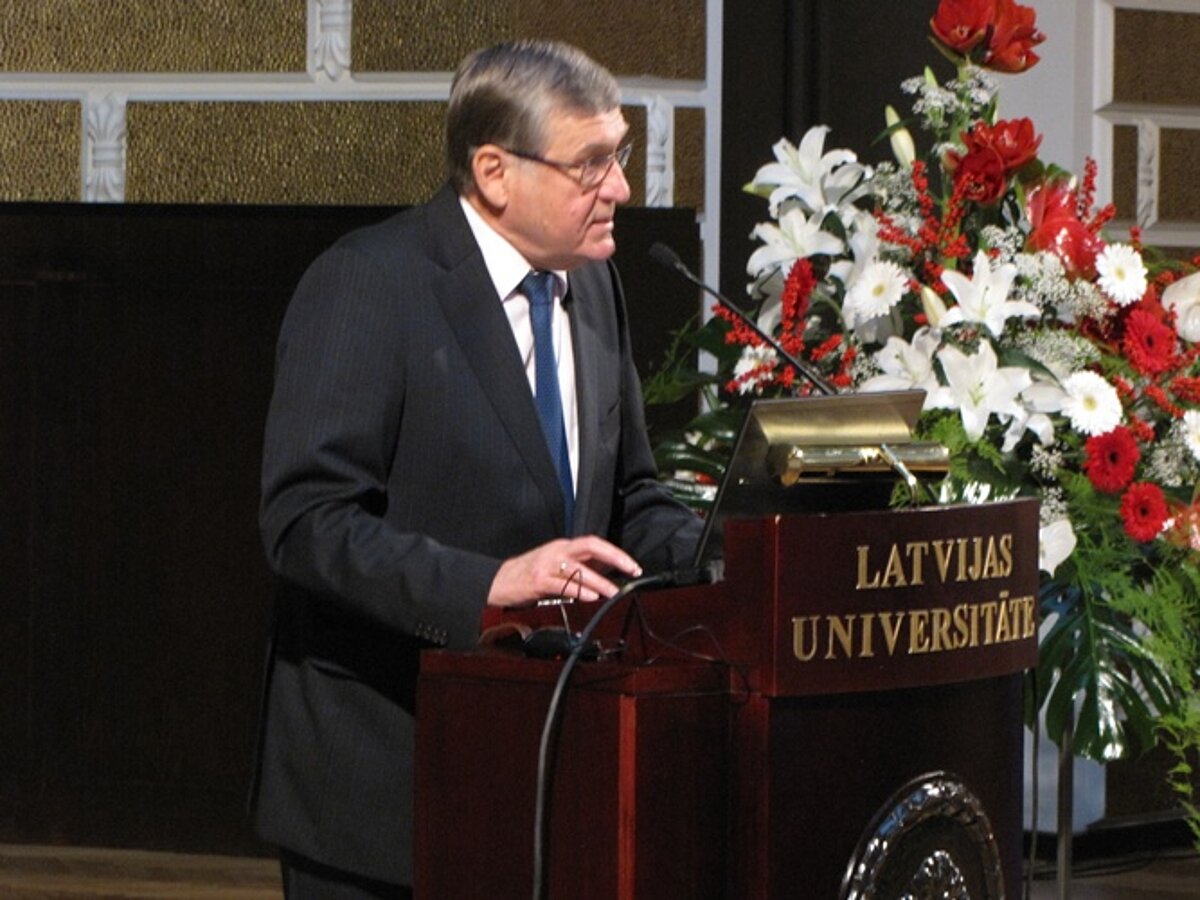
 hosted a presentation on the results of the education quality survey International Assessment of Latvian Students’ Performance in Mathematics, Science and Reading. The survey was conducted by the Organisation for Economic Cooperation and Development (OECD). )