
 CONFERENCE

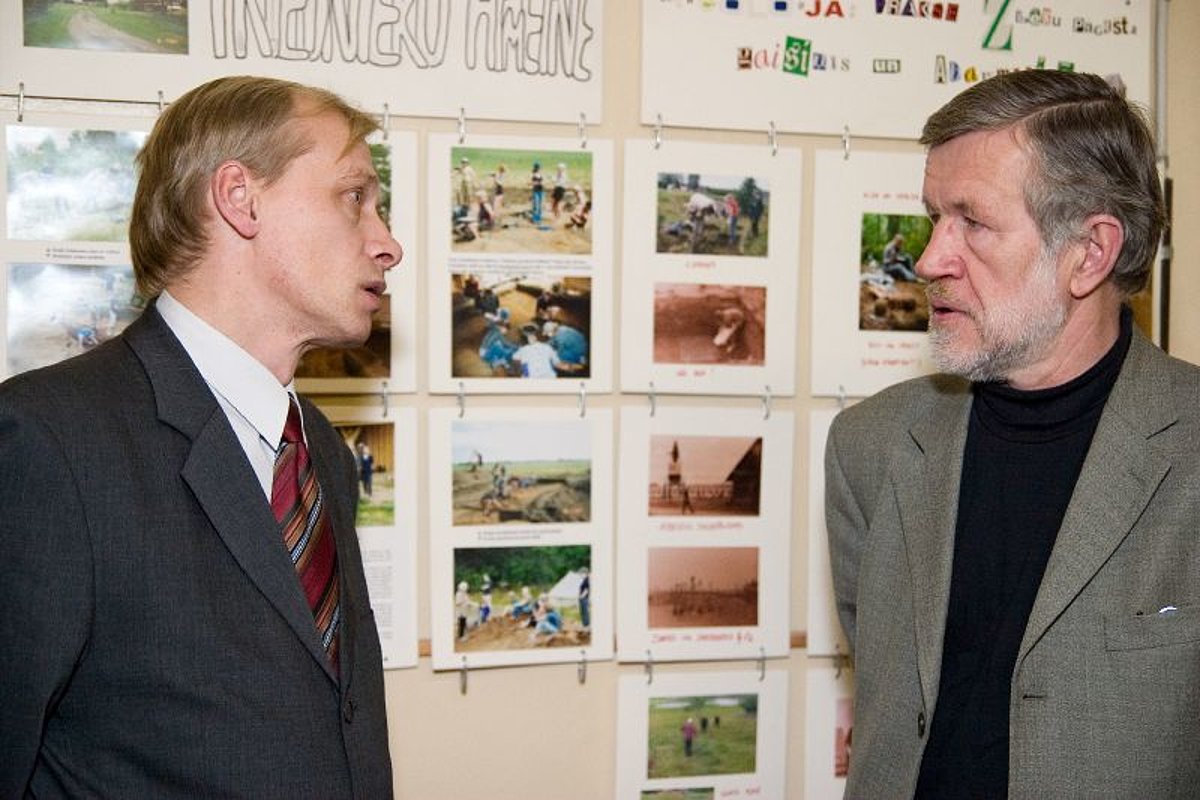



During the interview the professor highlights the most remarkable stages of Latvian archaeology starting with the 18th century, when it was only in the stage of collectionism. According to the professor, in Soviet times wide-ranging excavations began after the construction of power stations on the river Daugava; during the early 1990s there was a pause in the development of Latvian archaeology – just some minor excavations took place; the second half of the 1990s, however, saw a particular revival, when professor Vasks together with his colleague Armands Vijups and in cooperation with professor Juris Zaķis, then the rector of the University of Latvia, helped restore the tradition of the archaeological practice. But what’s going on in the business now, we'll find out in the conversation.
Professor, you have just returned from an archaeological expedition. Please, tell us where you have been and what seemed worthy of note to you?
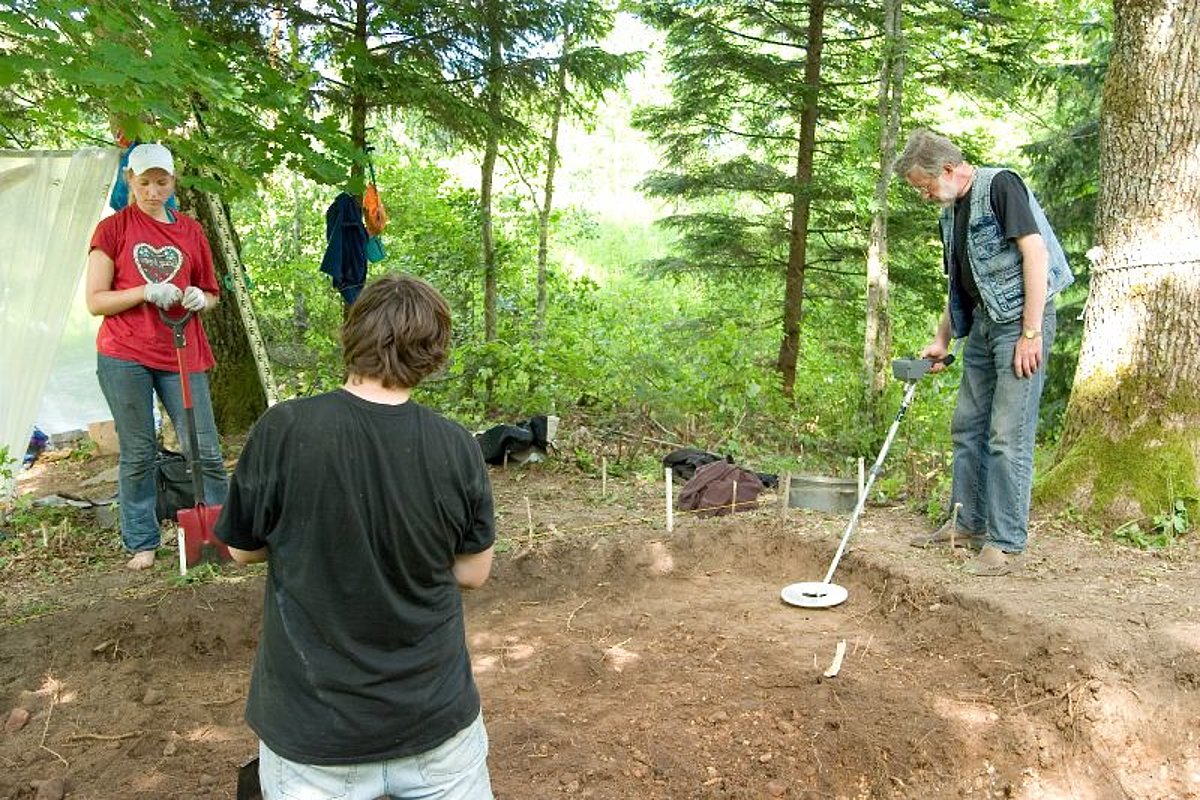
This summer my students and I have made a research trip to hillfort Krievu Kalns in Skrunda. Initially it wasn’t entirely clear whether or not Krievu Kalns is a hillfort. In the 1920s and 1930s well-known Latvian hillfort researcher Ernests Brastiņš did not consider this hill a hillfort; according to Brastiņš, it didn’t have hillfort-characteristic traits. However, the question remained open: while the name Krievu Kalns didn’t appear in the hillfort lists, the State Inspectorate for Heritage Protection database mentions Skrunda Krievu Kalns as a hillfort.
Moreover, the Archaeology Department of the National History Museum of Latvia has been receiving various accidental findings from this site – fragments of clay crockery with special hatching on the upper side – since as early as the 1930s. To a certain extent it indicates that ceramics and fortified settlement on Krievu Kalns could date from as far as the Late Bronze Age.
Since historical monuments of the Bronze Age in the western part of Latvia have been studied less than those in the country’s east, our faculty currently organizes archaeological practice for students in Western Latvia. Hence the choice of Krievu Kalns. The excavation works there lasted three weeks. The found objects and obtained results are quite interesting and are currently being studied. We have also found remnants of the fortification, so there’s no doubt that Krievu Kalns is a hillfort – a fortified dwelling place dating back to the late Bronze Age. As usually, a lot of clay chips have been found, which is characteristic of a settlement.
There are, of course, many other curious findings: a student has found a snail-head pin, which is very interesting, because I haven’t heard of any other such pins to be found in Latvia. Another nice finding is an amber button fragment.
The number of objects found is quite moderate, but all the structural remnants, fortification walls and other findings indicate that it is a hillfort, which was inhabited in the late Bronze Age – from 1100 to about 500 BC. It is also possible that it was inhabited even later, during the period called the earliest Iron Age – from 500 BC up to the turn of ages, however, no supporting evidence was found in this regard.
Prehistory is the earliest period of history and archaeological discoveries are essential reference objects for researchers – the results of their study help schoolchildren get an insight into the relevant time period. In this way children can learn what is family, people and Motherland, how our ancestors lived starting with the first settlers that came to our land many thousands of years ago, as well as the ethnic composition, everyday life and material and spiritual culture of the population on the territory of Latvia. What else could you add about and how could you characterize the importance of archaeology and archaeological discoveries for modern Latvia?
Archaeological excavations are a way to obtain these historical sources, which help us explain the earliest period of Latvia’s history. First of all, we are speaking about prehistory – a period providing no written sources. Archaeology studies the so called historic period too. The branches are called Medieval and Contemporary Archaeology. Perhaps these findings are less important than those of the prehistoric period, but the information they provide is like a small brick in the prehistoric building that we are trying to reconstruct. Prehistory itself is the reconstruction of our history. It’s about how we put the facts and archaeological material together, how we interpret them, what conclusions can we draw from them.
In a sense, it is a reconstruction, where between a mute object and a living story there is the researcher, who tries to interpret material sources into plain language, understandable to all people.
Archaeological discoveries are indeed of great importance, because in Latvia, similarly to Scandinavian countries, written sources have appeared relatively recently.
How would you explain to a person not familiar with archaeology what is this science?
Speaking in jest, archaeology is a science with a spade. However, if said seriously, archaeology is a subsector of history science that studies material evidences left by previous generations. Based on them, scientists reconstruct the processes in the social life of the past. With the help of archaeology you can study both the traces of a very distant past – Stone Age, Neolithic, Mesolithic and even Palaeolithic Age – and quite recent periods.
After the restoration of national independence so called terror archaeology became very poplar in the Baltic region. It consisted in carrying out excavations on various state terrorism victim burial sites using archaeological methods. For example, in this way Estonians found the burial place of their president Konstantin Päts in Estonia. The Latvian group, of which I am a member, went to Krasnovodsk (since 1993 – Turkmenbashi, Turkmenistan), in search of Kārlis Ulmanis’ traces. Unfortunately, we failed, because in our case the circumstances were quite different.
Since archaeology allows studying the broadest range of time periods, objects older than two hundred years are considered true archaeological objects, whereas those that are younger receive historical monument status.
Having familiarized oneself with your professional activity, achievements and discoveries, it could be said that your work is permeated with energetic charm. Your work carries away lots and lots of enthusiastic students – future experts in archaeology. You could even work through a vacation, because at times scientific work requires continuity. What drives your progress?
There is a joke that archaeology is not a science but a diagnosis. Moreover, one wishes to leave somebody to continue the work after retiring from archaeology.
Therefore it is important to work with students. Unfortunately, there aren’t many job opportunities for a certified archaeologist in Latvia, but we have managed to fill those available: our young specialists work in the Department of Archaeology of the Institute of Latvian History and in the National History Museum, which has a large archaeological department. The State Inspectorate for Heritage Protection and the Museum of the History of Riga and Navigation have small departments for our specialists too.
So, we could conclude that there still are people interested in archaeology and their number is increasing. I am particularly glad about that. Students show keen interest to participate in field trips. They sign in for practice and look forward for each next expedition. In this regard the demand exceeds the offer. It’s a kind of hobby for young archaeologists. As for me, I have a pedagogical task of guiding these young people.
Any coin has two sides – one bright and sunny, and one not-so-shiny. What are the difficulties of your work? What advice could you give to a young enthusiast who has decided to study archaeology and is eager to uncover the history of Latvia with a spade in both hands?
To my mind, an archaeologist isn’t much different from a historian. Firstly, the sources must be studied. These are written documents. For an archaeologist these also are physical things. The more they study and learn and are capable of, the wider their outlook. The next thing is to follow the latest archaeological literature – both Latvian and foreign. Scientific work is a creative process. In most cases it is a life-long activity. Even upon retiring a scientist continues to work – study, write – for as long as they can.
Speaking about the other side of the coin, every job has it. Take the organization of practice – the first and foremost is the financial issue. In this regard I must thank the State Culture Capital Foundation that has been supporting us from the very beginning in 1999. Without its support field trips would be impossible to organize. I also thank the University of Latvia History and Philosophy Faculty for cooperation. Then, you must draw up projects and obtain excavation permits from the State Monument Inspectorate. But those aren’t inextricable difficulties, rather – a part of the job.
There are hillforts of Kurzeme, Īdeņa at the Lake Lubāns, ancient settlements in Latgale and many other places around the country. Is there any added value in working in such diverse places across Latvia – not just in carrying out archaeological excavations but also establishing contacts with people living nearby the places of interest?
Of course, there is. One of the archaeologist's duties and tasks is to survey the locals about the subject the archaeologist is interested in. They might know or have found something. Moreover, expeditions for gathering information about monuments are organized. A group of researchers would arrive at a particular place and survey the local people about whether they have found any things, old clothes, bones etc. In this way many historical monuments have been discovered. The contacts established with local people are maintained. Archaeologist is a rare profession, so it often arouses peoples’ interest – what exactly do they do? Archaeologists often get mixed up with geologists, because the latter seem to sound more familiar. Speaking about communication, we cooperate with municipalities too. Upon their request we send materials – photos and descriptions of objects that were found and events that occurred in particular places.
You have told us about the job details, but what about the cooperation with students? What is our new archaeologist generation like?
The cooperation begins as early as during writing the term papers. When choosing topics during the 1st study year, some students give preference to archaeology and come to our department that includes three staff members – apart from me there is associated professor Armands Vijups and faculty dean docent Andris Šnē. Student’s interests are very important for choosing a topic: it is necessary to consider what is closer to the student – their home region, a nearby district, etc. The writing process goes differently in different students and the results vary too, especially considering that some write their papers at the last minute.
The cooperation continues at during writing the bachelor thesis. In the ideal case it is developed from a term paper written earlier. Sometimes unusual situations occur as well: a student once arrived at an archaeology-related BA paper topic in the process of working over a term paper dealing with the events of the 1905 Russian Revolution. Here I would like to highlight the importance of archaeological practice; often a student becomes so much carried away with archaeology that they are ready to change the direction of their research. The next step is master studies and in some cases – doctoral studies. Currently we have a small group of students writing their doctoral theses in archaeology.
What are the topics that your doctoral students are currently working on?
They are different. Mostly related to the Iron Age. For example, Elīna Guščika is writing about the early and middle Iron Age burial grounds in Central Latvia and Central Northern Lithuania. Inna Lazdiņa, a very talented student, is writing about Iron Age male belts, which then were considered a most beautiful garment. Artūrs Tomsons is currently preparing to present his thesis dedicated to double-edged swords. Rūdolfs Brūzis is writing about medieval weapons; his supervisor is professor Armands Vijups. Recently another student working under Armands Vijups’ guidance – Vitolds Muižnieks – has successfully presented his thesis about burial customs of the historic period.
Our students’ theses are very diverse, although it must be said that up until now the Stone Age has been insufficiently studied, so we must encourage students to take up that period so that all prehistoric periods are covered. Generally speaking, the new generation of archaeologists is just fine. They are people who know what they want, and they put their heart and soul in their work.
About series of articles Researcher of the Month
Many researchers from various fields work at the University of Latvia with science in mind and soul. Among them are both those who already have a significant amount of scientific publications on their record and those just discovering the full beauty of scientific research. To say a word of grace to science and also have a look behind the curtain of faculties and institutes of the University of Latvia and tell the researchers’ stories to our friends and all others, the series Researcher of the Month has started in January 2012. Each month we publish a fresh story from one of our researchers at the University of Latvia portal. At the end of the year we’ll ask the portal readers to choose their favourite scientist and fete the one whose work has reached the most readers.
Researcher of the Month. In the name of science!
Translated by students of the professional study programme Translator of the University of Latvia.
