
 CONFERENCE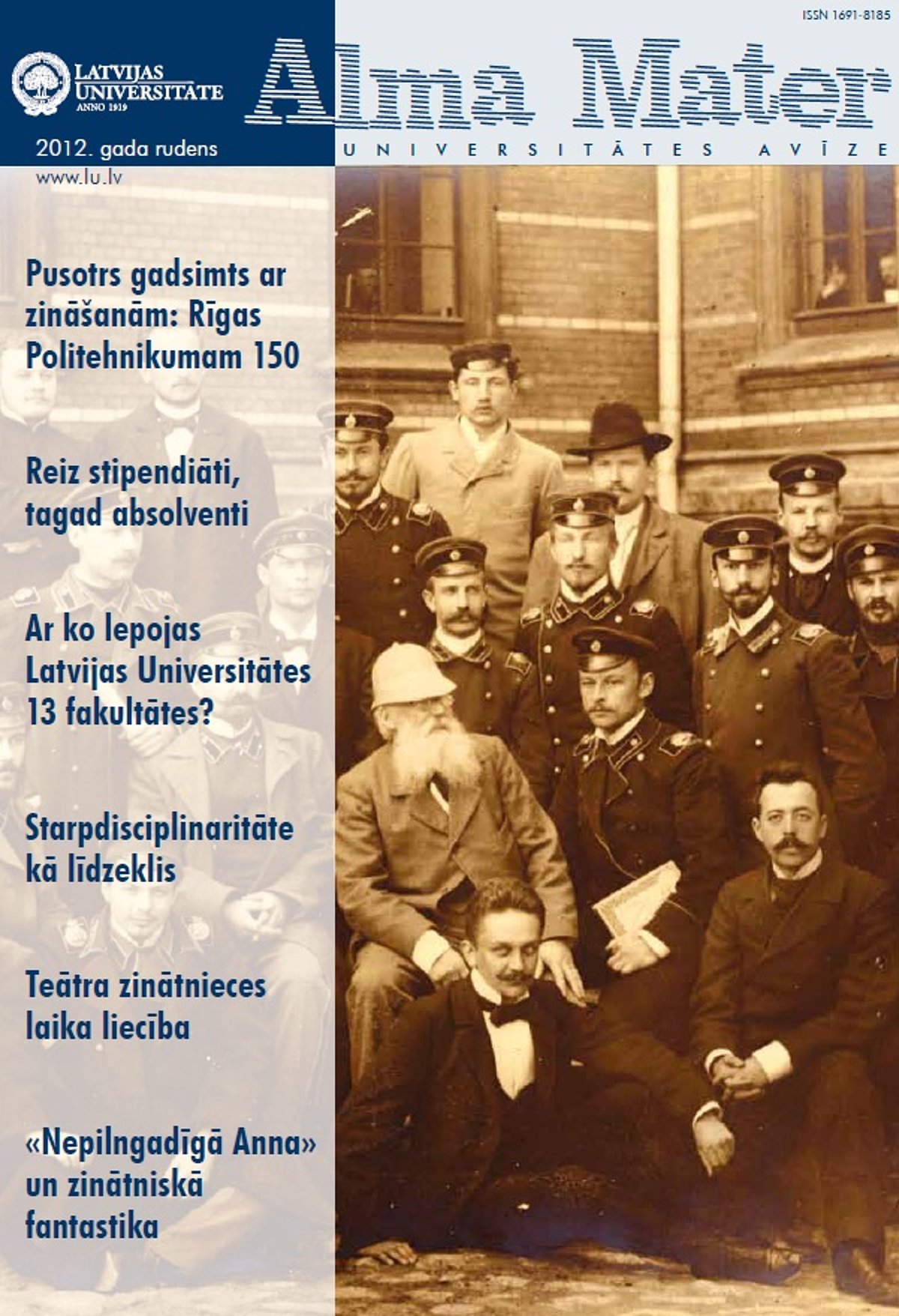
Contents include:
Remember your Alma Mater
Jeļena Poļakova
Each year thousands of students graduate the University of Latvia, receive a higher education diploma and continue their journey for their big dreams. Many of them rejoin the community of the University of Latvia in order to once again walk down the Central Stairs with a diploma in their hands. Each year brings the University new meetings and partings. A parting is more pleasant if it’s not long. It’s always great, when an alumnus doesn’t forget their Alma Mater and supports it in word and deed. This year the University of Latvia celebrates its 93rd birthday. During all these years thousands of students had graduated from it. Many of them stayed in touch with their Alma Mater and passed their University links over to their children and grandchildren. University of Latvia is grateful to every alumnus, who remembers it and supports it with ideas and helps new students by providing scholarships and engaging in various projects. This article tells about graduates of the University of Latvia and the people who, being the alumni grandchildren, identify themselves with the University of Latvia and support it in different ways.
(De)coding theatre, science and life
Gita Siliņa
This article offers a conversation with the head of University of Latvia Faculty of Humanities Department of Latvian and Baltic Studies Chair of Theatre and Cinema History and Theory, professor Dr. hab. artis Silvija Radzobe, whose monograph called «On the Stage and Behind the Curtain» (Uz skatuves un aiz kulisēm, «Zinātne,» 2011) has come out recently. In the interview, professor tells about her book and future plans and shares her vision on what is currently going on in theatres of Latvia and in the world of art, as well as in the academic field of theatre science.
Interdisciplinarity as a tool, not an ultimate goal
Jeļena Smelova
The leading researcher of University of Latvia Faculty of Education, Psychology and Art, Dr. paed. Karine Oganisjana speaks about the results of the first phase of the ESF project «Support for Educational
Researches» (Atbalsts izglītības pētījumiem) ASEM research «Improving teachers’ professional competences to work in interdisciplinary educational environment in order to approximate the studies to reallife conditions and elevate schoolchildren’s enterprise» (Pedagogu profesionālo kompetenču pilnveide darbam starpdisciplinārā mācību vidē, lai tuvinātu mācības reālajai dzīvei un paaugstinātu skolēnu
uzņēmību» pirmā posma rezultātiem). This September sees the release of her book «Entrepreneurial Disposition and Enterprise» (Uzņēmējspēja un uzņēmība) d iscussing a m ethodology f or d eveloping teachers’and schoolchildren’s enterprise and entrepreneurial disposition in interdisciplinary educational environment. The methodology has been worked out by the author on the basis of theoretical conclusions (part 1 and 2) in her doctoral research «The Development of Students’ Enterprise in Study Process» (Studentu uzņēmības veicināšana studiju procesā) and 25 years of educational experience. The author has developed the practical materials and interdisciplinary tasks on the basis of her experience of teaching physics, mathematics and English language at school and general pedagogy at university. The methodology and materials have been tested in Latvia and internationally.
150 years of knowledge
Aija Fedorova
150 years ago the first multidisciplinary technical university in the Russian Empire – Riga Polytechnicum – was opened. It employed internationally recognized scientists and its study programmes prepared theoretically and practically grounded generalists in chemistry, construction engineering, agriculture, mechanical engineering, commerce, architecture and land surveying. Until 1896 the lectures were conducted in English and afterwards – in Russian. Along with the language, the university structure changed and its name was replaced with Riga Polytechnic University. The university graduates included notable persons as well as experts and scientists in Latvian national economy, finances, manufacturing industry, agriculture and commerce, whose contributions helped make Riga an important learning and scientific research centre. After the official liquidation of Riga Polytechnicum in 1919 a great deal of its teaching staff and graduates became actively involved in the creation of the University of Latvia (UL). UL adopted and preserved the achievements of Riga Polytechnicum and provided for the development of the technical sciences. In 1958 a new university of technical sciences was established on the basis of four UL faculties. Referring to historical events, it was named Riga Polytechnical Institute, and in 1990 it received a name known up to the present days – Riga Technical University.
The pride of the University of Latvia faculties
UL Press Centre
The University of Latvia has 13 faculties, which not only educate new students but also are places, where active scientific and research work is conducted. This article offers an insight into the most important, interesting and creative researches that have been carried out at the faculties during the last five years by actively involving the scientific personnel, teachers and even students! Presented below are the researches conducted at all 13 UL faculties, which include carrying out scientific projects, issuing books and even discovering a new extinct animal species!
Once scholarship holders, now graduates
Jeļena Poļakova
Each year able and motivated students get a chance to receive a scholarship offered by the University of Latvia Foundation (ULF) patrons. Each year a part of the scholarship holders graduate the University of Latvia (UL). But what do UL alumni and ULF scholarship holders do after receiving their diploma and leaving the walls of the University? In the conversation with three UL alumni and holders of the ULF scholarships we found out what they are doing at the moment and what role the University and the scholarships played in their lives.
Diversified experience as the main benefit of a Fulbright fellowship
Džineta Dimante
University of Latvia Faculty of Economics and Management assistant professor Džineta Dimante received a Fulbright Research Fellowship and went to Hamline University in Saint Paul, Minnesota, USA. As a University of Latvia assistant professor, Mrs. Dimante teaches courses related to environmental economics and entrepreneurship, therefore research «Teaching Environmental Economics from the Perspective of Sustainable Development» (Vides ekonomikas mācīšana no ilgtspējīgas attīstības viedokļa) that was proposed for the Fulbright fellowship mainly focuses on environmental economics. However, she also got
many new opinions and practical examples about other study courses. Mrs. Dimante admits that an opportunity to visit several United States universities gave her an incentive to further improve her both academic and research work. Džineta Dimante recommends all her colleagues at both the University of Latvia and other Latvian universities to apply for a Fulbright fellowship for research work or lecturing.
«Nepilngadīgā Anna»: playing science fiction
Jeļena Smelova
The band «Nepilngadīgā Anna» deserves a special attention. It has not only secured a strong victory at the university of Latvia new band competition «Hadrons 2012» but also received a people’s choice award. While we are waiting for the band’s performance at the Aristotle Festival, let’s take a look at their daily life and melody secrets. This article provides an insight into the band’s musical, lyrical and life philosophy.
Remember your Alma Mater
Jeļena Poļakova
Each year thousands of students graduate the University of Latvia, receive a higher education diploma and continue their journey for their big dreams. Many of them rejoin the community of the University of Latvia in order to once again walk down the Central Stairs with a diploma in their hands. Each year brings the University new meetings and partings. A parting is more pleasant if it’s not long. It’s always great, when an alumnus doesn’t forget their Alma Mater and supports it in word and deed. This year the University of Latvia celebrates its 93rd birthday. During all these years thousands of students had graduated from it. Many of them stayed in touch with their Alma Mater and passed their University links over to their children and grandchildren. University of Latvia is grateful to every alumnus, who remembers it and supports it with ideas and helps new students by providing scholarships and engaging in various projects. This article tells about graduates of the University of Latvia and the people who, being the alumni grandchildren, identify themselves with the University of Latvia and support it in different ways.
(De)coding theatre, science and life
Gita Siliņa
This article offers a conversation with the head of University of Latvia Faculty of Humanities Department of Latvian and Baltic Studies Chair of Theatre and Cinema History and Theory, professor Dr. hab. artis Silvija Radzobe, whose monograph called «On the Stage and Behind the Curtain» (Uz skatuves un aiz kulisēm, «Zinātne,» 2011) has come out recently. In the interview, professor tells about her book and future plans and shares her vision on what is currently going on in theatres of Latvia and in the world of art, as well as in the academic field of theatre science.
Interdisciplinarity as a tool, not an ultimate goal
Jeļena Smelova
The leading researcher of University of Latvia Faculty of Education, Psychology and Art, Dr. paed. Karine Oganisjana speaks about the results of the first phase of the ESF project «Support for Educational
Researches» (Atbalsts izglītības pētījumiem) ASEM research «Improving teachers’ professional competences to work in interdisciplinary educational environment in order to approximate the studies to reallife conditions and elevate schoolchildren’s enterprise» (Pedagogu profesionālo kompetenču pilnveide darbam starpdisciplinārā mācību vidē, lai tuvinātu mācības reālajai dzīvei un paaugstinātu skolēnu
uzņēmību» pirmā posma rezultātiem). This September sees the release of her book «Entrepreneurial Disposition and Enterprise» (Uzņēmējspēja un uzņēmība) d iscussing a m ethodology f or d eveloping teachers’and schoolchildren’s enterprise and entrepreneurial disposition in interdisciplinary educational environment. The methodology has been worked out by the author on the basis of theoretical conclusions (part 1 and 2) in her doctoral research «The Development of Students’ Enterprise in Study Process» (Studentu uzņēmības veicināšana studiju procesā) and 25 years of educational experience. The author has developed the practical materials and interdisciplinary tasks on the basis of her experience of teaching physics, mathematics and English language at school and general pedagogy at university. The methodology and materials have been tested in Latvia and internationally.
150 years of knowledge
Aija Fedorova
150 years ago the first multidisciplinary technical university in the Russian Empire – Riga Polytechnicum – was opened. It employed internationally recognized scientists and its study programmes prepared theoretically and practically grounded generalists in chemistry, construction engineering, agriculture, mechanical engineering, commerce, architecture and land surveying. Until 1896 the lectures were conducted in English and afterwards – in Russian. Along with the language, the university structure changed and its name was replaced with Riga Polytechnic University. The university graduates included notable persons as well as experts and scientists in Latvian national economy, finances, manufacturing industry, agriculture and commerce, whose contributions helped make Riga an important learning and scientific research centre. After the official liquidation of Riga Polytechnicum in 1919 a great deal of its teaching staff and graduates became actively involved in the creation of the University of Latvia (UL). UL adopted and preserved the achievements of Riga Polytechnicum and provided for the development of the technical sciences. In 1958 a new university of technical sciences was established on the basis of four UL faculties. Referring to historical events, it was named Riga Polytechnical Institute, and in 1990 it received a name known up to the present days – Riga Technical University.
The pride of the University of Latvia faculties
UL Press Centre
The University of Latvia has 13 faculties, which not only educate new students but also are places, where active scientific and research work is conducted. This article offers an insight into the most important, interesting and creative researches that have been carried out at the faculties during the last five years by actively involving the scientific personnel, teachers and even students! Presented below are the researches conducted at all 13 UL faculties, which include carrying out scientific projects, issuing books and even discovering a new extinct animal species!
Once scholarship holders, now graduates
Jeļena Poļakova
Each year able and motivated students get a chance to receive a scholarship offered by the University of Latvia Foundation (ULF) patrons. Each year a part of the scholarship holders graduate the University of Latvia (UL). But what do UL alumni and ULF scholarship holders do after receiving their diploma and leaving the walls of the University? In the conversation with three UL alumni and holders of the ULF scholarships we found out what they are doing at the moment and what role the University and the scholarships played in their lives.
Diversified experience as the main benefit of a Fulbright fellowship
Džineta Dimante
University of Latvia Faculty of Economics and Management assistant professor Džineta Dimante received a Fulbright Research Fellowship and went to Hamline University in Saint Paul, Minnesota, USA. As a University of Latvia assistant professor, Mrs. Dimante teaches courses related to environmental economics and entrepreneurship, therefore research «Teaching Environmental Economics from the Perspective of Sustainable Development» (Vides ekonomikas mācīšana no ilgtspējīgas attīstības viedokļa) that was proposed for the Fulbright fellowship mainly focuses on environmental economics. However, she also got
many new opinions and practical examples about other study courses. Mrs. Dimante admits that an opportunity to visit several United States universities gave her an incentive to further improve her both academic and research work. Džineta Dimante recommends all her colleagues at both the University of Latvia and other Latvian universities to apply for a Fulbright fellowship for research work or lecturing.
«Nepilngadīgā Anna»: playing science fiction
Jeļena Smelova
The band «Nepilngadīgā Anna» deserves a special attention. It has not only secured a strong victory at the university of Latvia new band competition «Hadrons 2012» but also received a people’s choice award. While we are waiting for the band’s performance at the Aristotle Festival, let’s take a look at their daily life and melody secrets. This article provides an insight into the band’s musical, lyrical and life philosophy.
- <link eng general press almamater>Magazine "Alma Mater"
