
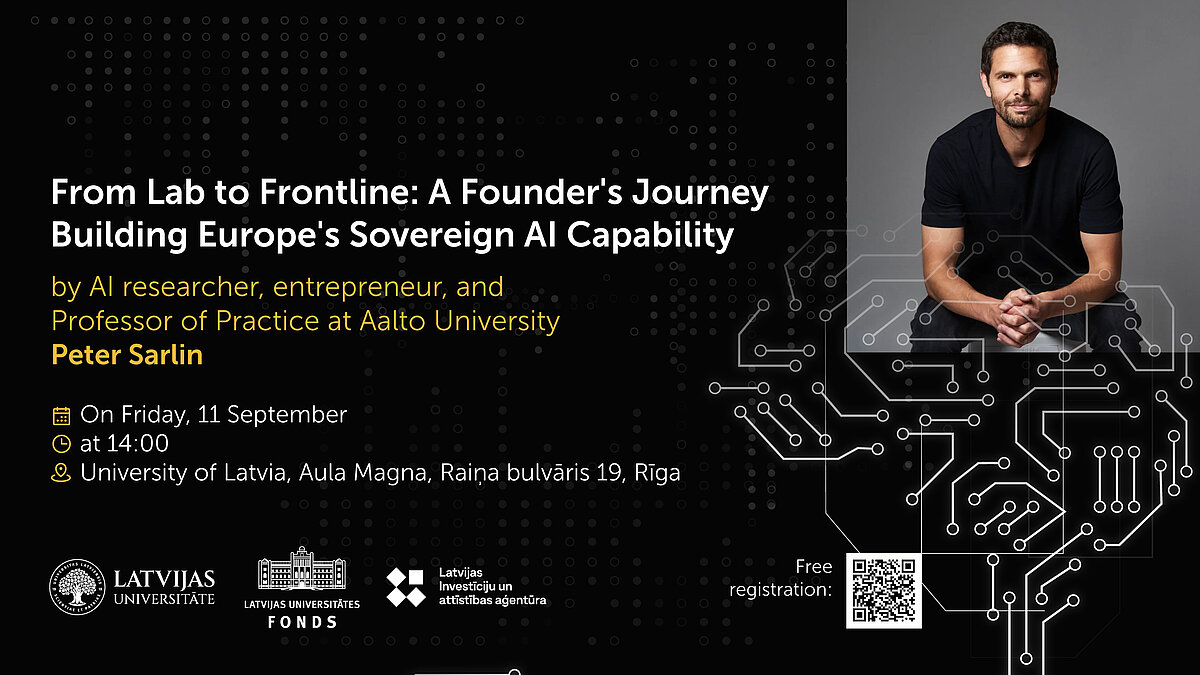
The lecture, “From Lab to Frontline: A Founder’s Journey Building Europe’s Sovereign AI Capability” will take place on September 11 at 2:00 p.m. in the Aula Magna of the University of Latvia. Those interested are invited to register for free participation.
Peter Sarlin will share his experience and insights on how AI research developed in Europe can be transformed into sovereign technological capability – knowledge, companies, and technologies that are developed and remain in Europe.
Peter Sarlin is the founder and Chairman of the Board of Foundation PS and PostScriptum. PostScriptum is a platform from which companies such as NestAI, Qutwo, and Silo AI have emerged and been developed. Through Foundation PS, he has funded 13 professorships at ELLIS Institute Finland. Under his leadership, Silo AI became one of Europe’s largest private AI laboratories and was acquired by AMD in 2024, in what was, at the time, the largest AI company acquisition in Europe.
Meanwhile, NestAI, the European AI laboratory for the defence sector that he founded, works with the Finnish and Estonian armed forces and has raised €100 million from Nokia and Tesi.
The company Qutwo, founded by Sarlin, develops next-generation AI solutions for quantum computing, extending his vision of European technological sovereignty to the level of the computing infrastructure on which AI itself depends.
Peter Sarlin holds a PhD in machine learning and has held academic positions at several universities, including Imperial College London, the London School of Economics and Political Science, and the University of Technology Sydney. During his professional career, he has also worked at the European Central Bank and the International Monetary Fund.
The guest lecture is organized by the University of Latvia and the University of Latvia Foundation in cooperation with the Investment and Development Agency of Latvia.
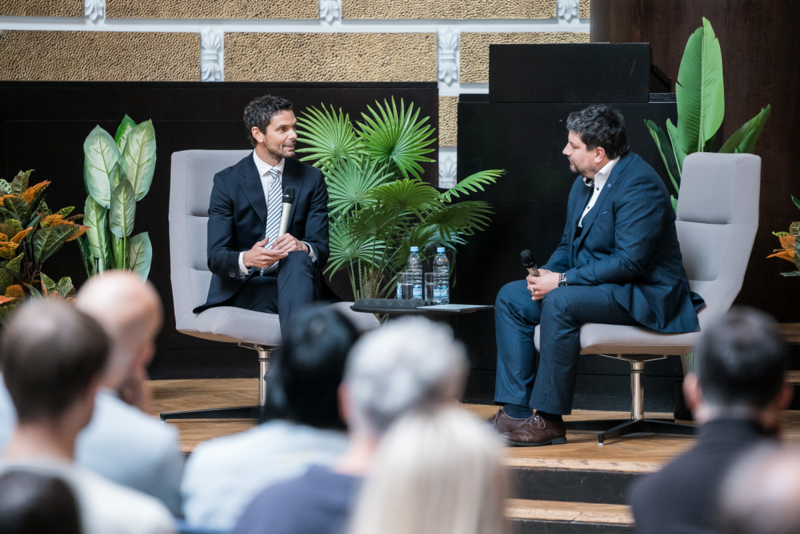
 will host a guest lecture by Peter Sarlin, a prominent European artificial intelligence entrepreneur, co-founder of Silo AI – one of Europe’s largest private AI laboratories – and Professor of Practice at Aalto University.)