
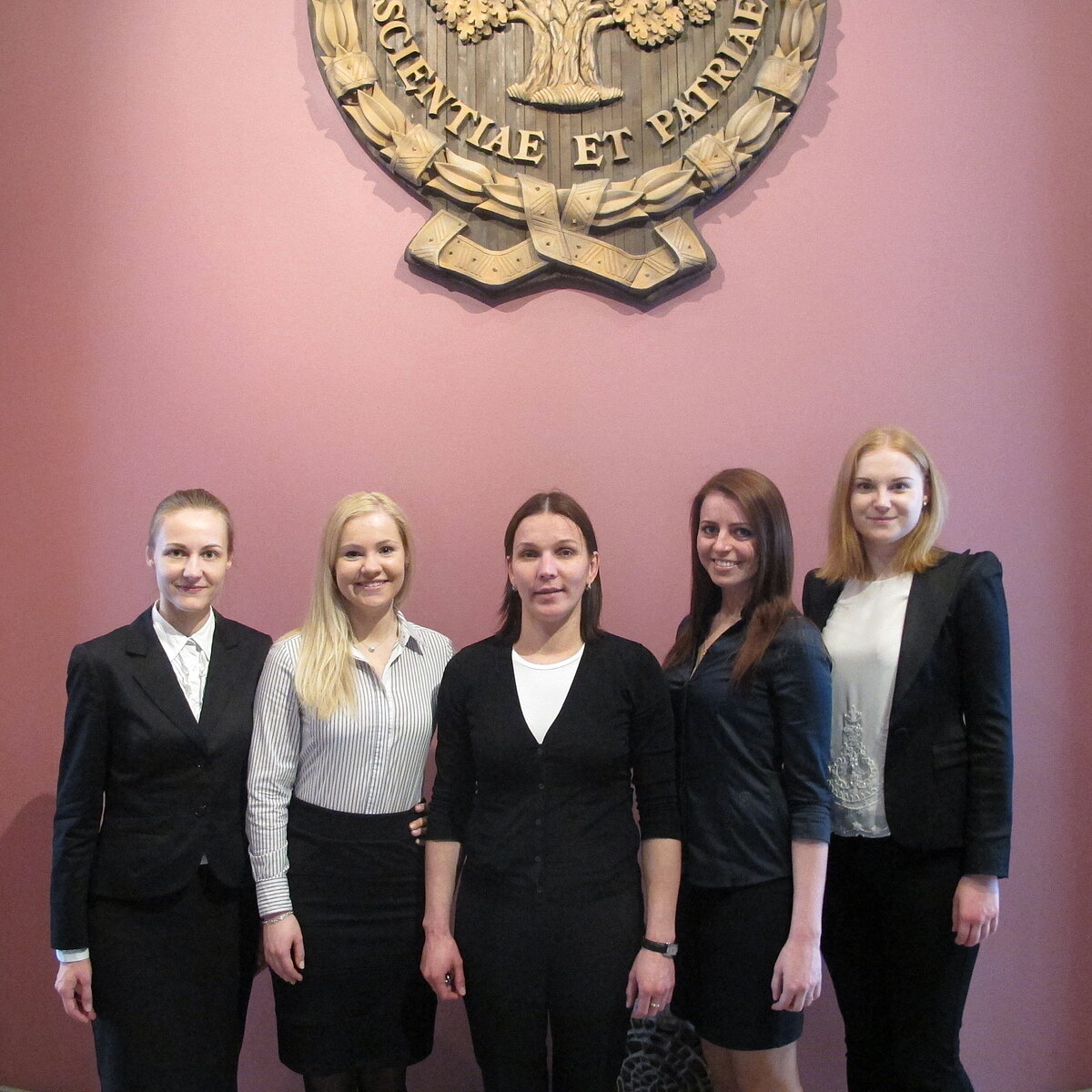
This was a special year for the European Law Moot Court Competition, as its 25th anniversary was celebrated and, in addition, the organizers admitted that this was the highest number of all time for teams applying and sending in their written pleadings. Nearly all of the written pleading were recognised as exceptionally good and therefore it was very hard to select the 49 best teams for the oral rounds. Only on April 13th, 2013 at the Grand Final in Luxembourg the Competition ended with the victory of the University of Leiden.
This year’s case[1] was quite complicated and consisted of various European law problems. The key elements were Article 101 of the TFEU concerning competition restrictive agreements, Article 4 of the TEU about the constitutional core of the Member States, as well as the debate about the court of the last instance with an obligation to request the preliminary ruling to the Court of Justice of the European Union. It must be noted that the case was quite tangled and in some aspects the teams did not have any case law to refer to.
At the Neuchâtel Regional Final in Switzerland from February 21st – 24th the team from the University of Latvia proved to be competitive amongst other 12 best teams from different European universities. The day of the competition was intense and full of excitement for all participants. First from the Latvian team spoke Sandra Galilejeva on the behalf of the defendant. She showed courage and confidence while being able to perceive the applicant’s arguments and make appropriate counterarguments, which is the most important task for the defendant because the written pleadings of the opponent team are never available at this particular competition.
After a short break Anna Jakšpētere proved herself as the applicant. This, unlike others, is a bilingual moot competition, therefore the whole process is both – in English and French. But it was no obstacle to Anna, she perfectly speaks in both languages and, including the questions from the judges, finished her speech exactly at the moment when her time ran out (making the judges very pleased and joyful!).
Then it was time for Lilita Sergejeva to present the independent opinion of the Advocate General on the case. Advocate General is supposed to guide the court towards a fair judgment yet being a little bit original, and, undoubtedly, Lilita succeeded with this task. And last, but not least, an equally substantial role during the competition was played by Ketija Žubure when speaking together with Sandra and Anna. Ketija not only showed fantastic skills of teamwork and cooperation, but also helped to translate the opponent’s arguments from French and rebut them.
Finally, the team wants to dedicate many thanks to assistant professor Kristīne Dupate for the support, advice and training for more than a half year. A lot of hard work and time was invested under her guidance, an international recognition and success were acieved, as well as mutual friendship was born. Nonetheless, the team wants to thank the Dean’s Office of the University of Latvia Faculty of Law for the unforgettable experience and the opportunity to participate in this competition and also Jūlija Jerņeva, Debora Pāvila, Edmunds Broks, Arnis Buka, the speech consultant Ruta Vītiņa and others who helped to prepare for the moot competition.
[1] The case of 2012/2013 can be found here: zealot.mrnet.pt/mootcourt/index.php
[1] The case of 2012/2013 can be found here: zealot.mrnet.pt/mootcourt/index.php
