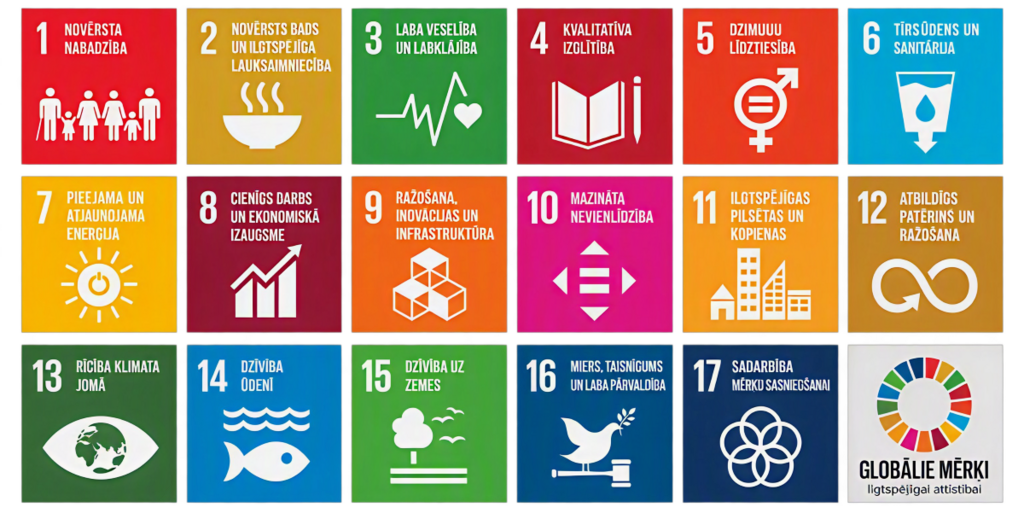
On 25 September 2015, the United Nations (UN) General Assembly adopted the resolution “Transforming our world: the 2030 Agenda for Sustainable Development”, also known as the 2030 Agenda. It establishes a shared framework for eradicating poverty, reducing inequalities, protecting the environment and promoting well-being. The Agenda comprises 17 Sustainable Development Goals (SDGs) and 169 targets, connecting the economic, social and environmental dimensions of sustainable development.
Achieving the Goals depends on cooperation among national and local governments, education and research institutions, businesses and society. The Goals call for responsible use of natural resources, equal opportunities and solutions that support the well-being of present and future generations. At the heart of the 2030 Agenda is the commitment to leave no one behind.
Sustainable Development Goals at the University of Latvia
On 31 January 2023, following a proposal by the UL Eco-Council, the Council of the University of Latvia approved the UL Sustainable Development Policy. It sets out the University’s sustainable development principles, priorities and main instruments for implementation. Further information on sustainability governance is available in the “Sustainability” section under Documents and Governance.
Sustainable development is a fundamental principle guiding the University of Latvia (UL) in education, research, organisational development, governance and cooperation with partners. At UL, it means responsibility towards people and the environment, integrating social, economic, environmental and human rights values into the University’s everyday activities and its relationships with students, employees, partners and society.
Through education, UL supports the acquisition of the knowledge, skills and competencies needed to address sustainability challenges. Interdisciplinary research helps explain environmental, social and economic change and develop science-based solutions. By making research findings accessible and strengthening cooperation with national and local authorities, businesses, non-governmental organisations and other universities, UL promotes the use of knowledge for public benefit.
In 2025, 425 UL research publications were associated with at least one SDG. The University's contribution also includes social assistance for students, energy efficiency improvements, the Community Garden, urban meadows and public learning activities.
Further information on activities and performance indicators is available in the UL Sustainability Report 2025 under “Sustainability Reports and Assessments”.