
 CONFERENCE
About our groups
The long-term goal of the MPMI research group is to understand how intra-plant and inter-plant systemic signals affect and are shaped by plant beneficial microbiota in order to aid plant defence against pest and pathogen attacks. In particular, arbuscular mycorrhizal fungi form common mycelial networks (CMN) that interconnect plant roots and transmit stress signals between plants. Harnessing such inter-plant signaling offers opportunities to enhance disease resistance at the community level.
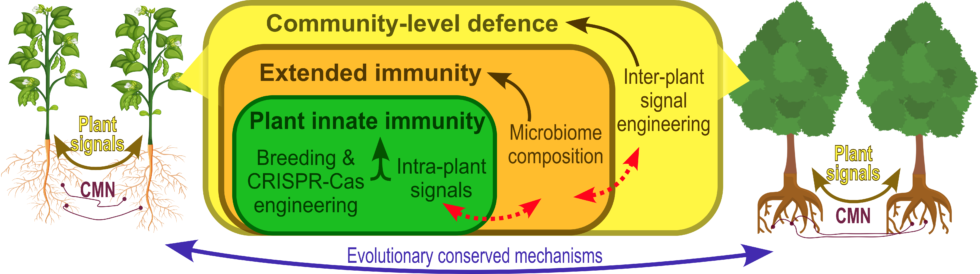
Our ambition is to make fundamental discoveries about CMN-dependent plant signaling mechanisms in model plants (Medicago truncatula, Daucus carota) as well as economically important and genetically tractable crop and tree species to uncover evolutionary conserved plant responses. The application of our research is aimed at sustainable bioengineering of plant responses to stress signals and supplementing plant microbiota to boost defence against pests and pathogens.
More information: Orlovskis Lab
Lab lead

Senior researcher, Assistant professor
Zigmunds Orlovskis
Harnessing mechanisms of mycorrhizal network-mediated plant-to-plant stress signals
E-mail: zigmunds.orlovskis@lu.lv
Team

Ayman Osman
Bioinformatics for discovery of small RNAs in common mycorrhizal network dependent plant signalling.

Naveen Arakkal Thaiparambil
Interaction of endemic plant growth promoting bacteria isolates and arbuscular mycorrhizal fungi for enhanced crop health.

Dawood Shah
Mechanisms for pathogen resistance and suceptibility in CMN-mediated plant signals.

Annija Kotova
Isolation and characterisation of mycorrhizal communities towards development of novel microbial preparations for plant growth.

Kārlis Trevors Blūms
Stress and pathogen responses of silver birch and hybrid aspen to CMN-mediated neighbor signals.
Projects
2026-2029 PLANT-NET: Exploring Fungal Network–Mediated Plant Communication Mechanisms for Novel Antimicrobials, Disease Resistance and Nanopesticide Innovation (University of Latvia High Impact Research Grants: 300’000 EUR)
2025-2028 MYCO-PREP: Harnessing mycorrhizas from Latvian soils for crop optimization and development of new microbiological preparations (European Regional Development Fund: 600’000 EUR)
2024-2026 Investigating the role of small RNAs in mycorrhiza-mediated plant-to-plant signals towards improved pathogen tolerance. (Latvian ANM grant:115’200 EUR)
2023-2025 Role of mycorrhizal fungi in inter-plant signalling and disease tolerance of hybrid aspen and silver birch. (Latvian Council of Science: 300’000 EUR)
2023-2024 Underground biological internet: functioning of common mycelial networks in inter-plant signalling (University of Latvia Foundation SIA Mikrotik): 20’000 EUR)
2022-2024 Investigate biotic stress induced inter-plant molecular signals and responses in mycorrhizal fungi-connected plants (Latvian Council of Science: 300’000 EUR)
Publications
- Orlovskis Z*, Voronins E, Kotova A, Pugacevskis D, Blums K, Nakurte I, Silamikelis I, Lee S-J (2026). Rhizophagus irregularis modulates neighbour-primed defences in Medicago truncatula against foliar pathogens via common mycelial network-mediated inter-plant signals. Communications biology https://www.nature.com/articles/s42003-026-10727-6
- Blūms KT, Krivmane B, Ramanenka M, Matisons R, Ruņģis D, Zeps M, Orlovskis Z* (2025). Species specific marker genes for systemic defence and stress responses to leaf wounding and flagellin stimuli in hybrid aspen and silver birch. PlosOne, doi: 10.1371/journal.pone.0344803
- Lee SJ, Li Wang L, Orlovskis Z* (2025) Harnessing plant-to-plant signalling via common mycorrhizal networks for enhanced community-level resistance in crops. Journal Experimental Biology doi.org/10.1093/jxb/erag159
- Matisons R, Orlovskis Z*, Blūms KT et al. (2024). Mycorrhizal Diversity on Roots of Silver Birch and Hybrid Aspen in Clonal Plantations in Northern Europe, Latvia. Forests 15: 2123, doi:10.3390/f15122123
- Orlovskis Z, Reymond, P. (2020). Pieris brassicae eggs trigger inter-plant systemic acquired resistance against a foliar pathogen in Arabidopsis. New Phytologist, doi: 10.1111/nph.16788
- Orlovskis Z*, Singh A, Kliot A, Huang W, Hogenhout SA (2025). Phytoplasma Targeting of MADS-Box Factor SVP Suppresses Leaf Responses to Insect Vector Males, Promoting Female Attraction and Colonization. eLife, doi.org/10.7554/eLife.98992.3
- Al-Subhi AM, Al-Sadi AM, Al-Yahyai RA, Chen Y, Mathers T, Orlovskis Z. et al. (2020). Witches’ brooms contribute to phytoplasma epidemics by boosting phytoplasma titers and attracting insect vectors. Plant Disease, doi.org/10.1094/PDIS-10-20-2112-RE
- Orlovskis Z, Canale MC, Kuo CH et al. (2017). A few sequence polymorphisms among isolates of Maize bushy stunt phytoplasma associate with organ proliferation symptoms in infected maize plants. Annals of Botany, doi:10.1093/aob/mcw213
- Orlovskis Z (2017). Role of phytoplasma protein effectors in plant development and defence against insects. PhD Thesis, John Innes Centre and University of East Anglia, https://ueaeprints.uea.ac.uk/63188/
- Orlovskis Z, Hogenhout SA (2016). A bacterial parasite effector mediates insect vector attraction in host plants independently of developmental changes. Frontiers in Plant Science, doi:10.3389/fpls.2016.00885
- Orlovskis Z, Canale MC, Thole V, et al. (2015). Insect-borne plant pathogenic bacteria: getting a ride goes beyond physical contact. Current Opinion in Insect Science, doi:10.1016/j.cois.2015.04.007
- MacLean AM, Orlovskis Z, Kowitwanich K, et al. (2014). Phytoplasma Effector SAP54 Hijacks Plant Reproduction by Degrading MADS-box Proteins and Promotes Insect Colonization in a RAD23-Dependent Manner. PLOS Biology 12(4): e1001835, doi:10.1371/journal.pbio.1001835
Elbere I$, Orlovskis Z$, Ansone L, et al. (2024). Gut microbiome encoded purine and amino acid pathways present prospective biomarkers for predicting metformin therapy efficacy in newly diagnosed T2D patients. Gut Microbes 16: 2361491, doi: 10.1080/19490976.2024.2361491
Tupciauskas R, Orlovskis Z, Blums KT, Liepins J, Berzins A, Pavlovics G, Andzs M (2024). Mold Fungal Resistance of Loose-Fill Thermal Insulation Materials Based on Processed Wheat Straw, Corn Stalk and Reed. Polymers 16: 562, doi:10.3390/polym16040562
Zikmanis P, [..], Orlovskis Z, Šilaks A, Semjonovs P. (2021) Microbial Polymers in Edible Films and Coatings of Garden Berry and Grape: Current and Prospective Use. Food and Bioprocess Technology, doi:10.1007/s11947-021-02666-3
Areas for searching partners
- Plant-mycorrhiza interactions
- Plant defence & immunity
- Plant systemic resistance
- Inter-plant signals
- Plant-pathogen interactions
- Plant-microbe-insect vector biology
- Plant growth promoting bacteria
- Soil biotehnology
- crop and forest solutions