
 CONFERENCE
Space TEM project
SpaceTEM is an EstLat project which aims to initiate the development of NewSpace (private space technology sector) industry in Estonia and Latvia through a series of mutual activities. These activities include:
Training the next generation of engineers with hands-on methods in the fields of NewSpace, through traineeships space technology development sector and space technology field summer schools;
Training the next generation of entrepreneurs in the fields of NewSpace through a series of startup events, workshops, hackathons, training, and camps;
Helping to create a better national environment for developing NewSpace industry through analysis of Estonian and Latvian space policy with the aim to harmonize policies;
Raising awareness of the NewSpace industry through space technology related workshops for journalists.
SpaceTEM is brought to life by Tartu Observatory as lead, University of Tartu, Estonian Student Satellite Foundation and sTARTUp Hub from Estonia and the University of Latvia, Ventspils University College, Heliocentric Technologies Latvia and Green and Smart Technology Cluster from Latvia.
SpaceTEM takes upon itself the task of unifying Estonian and Latvian students, entrepreneurs, universities and even policy makers in the field of space technology and NewSpace. Participants from both countries will work together to fill gaps in knowledge, share ideas and collaborate on the new initiative.
SpaceTEM is a project of EstLat program in a total sum of 583,350.00 EUR, of which 495,847.50 EUR is funded by European Regional Development Fund.
For the full information on SpaceTEM / Interreg go to the WWW pages:
Information about EstLat program can be found from EstLat webpage: www.estlat.eu
Program description in Latvian: at greentechlatvia.eu/lv/spacetem/
Summer internship closing conference in Riga
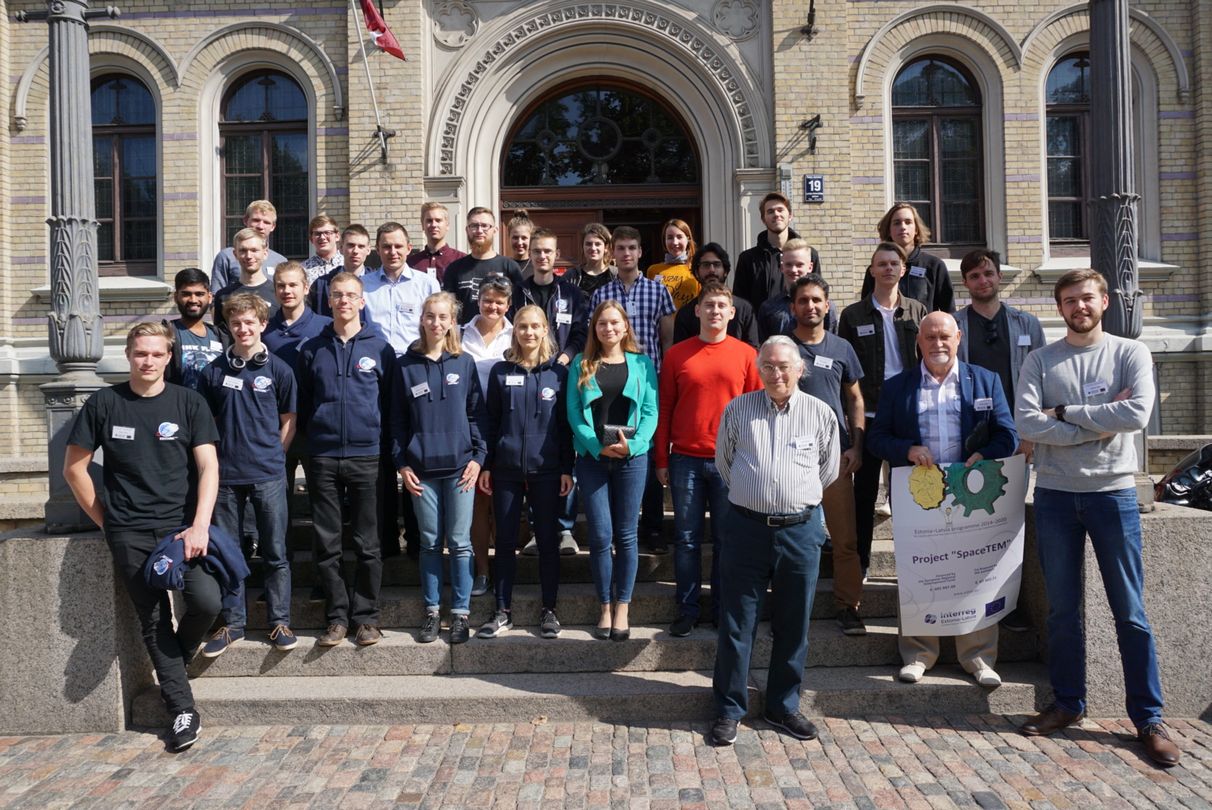
Pictured: seminar participants – students together with their internship supervisors and project representatives.
On August 30 and 31, 2018, 21 Latvian and Estonian students gathered at the University of Latvia to complete a ten-week internship at space technology-related companies in Latvia and Estonia as part of the Estonian-Latvian cross-border program project “Practical training of the new generation of entrepreneurs in the field of space TEM”. At the two-day seminar “SpaceTEM Student Conference 2018, Riga”, students from the University of Latvia, Ventspils University of Applied Sciences and the University of Tartu told their peers, internship supervisors and project management about what they had accomplished during the summer. New satellite and stratospheric balloon assemblies were designed, rocket control, astronomical data and satellite data processing algorithms were developed. Students acquired new programming skills, read scientific publications, worked together with scientists and engineers, learned to collaborate with each other and communicate with the public. This seminar was part of the three-year program "Practical training of the new generation of entrepreneurs in the field of space TEM", which aims to strengthen ties between space research institutions in Latvia and Estonia so that the next generation of engineers and scientists can more successfully engage in European Space Agency projects and other types of cooperation.
Students summer internship in Latvia
In 2018, the Institute of Astronomy of the University of Latvia continued its work in the Latvian-Estonian cross-border project “Practical training of the new generation of entrepreneurs in the field of space STEM”. This summer, the University of Latvia hosted four interns. Anna Bule, who is studying in the Bachelor's program in Physics at the Faculty of Physics and Mathematics of the University of Latvia, processed star observations at the Baldone Observatory, searching for new carbon stars. After finding a candidate carbon star, it must be checked whether it is already included in the catalogs. If it is a new carbon star, then its precise coordinates must be determined, its brightness, temperature and distance must be estimated. Robert Krautmann, who is studying materials science and sustainable energy at the Tallinn University of Technology, prepared a new weather station for operation at the satellite observation station of the Institute of Astronomy, which is necessary for determining atmospheric parameters during satellite laser ranging. One of the tasks was to calibrate the weather station's barometer using a second, high-precision absolute barometer.
In accordance with the project guidelines, other space-related companies that are not directly involved in the project are also supported. Therefore, this year, two students, Jain Ayush, who studies robotics and computer engineering at the University of Tartu, and Siri Talvistu, who studies spacecraft construction at Luleå University of Technology in Sweden, worked at SIA Heliocentric Technologies Latvia, which is building a rocket to reach the edge of space at an altitude of 100 kilometers. One of the tasks is the stabilization of the rocket and its control during flight. Both students created mathematical models of rocket stabilization and tested the best stabilization methods.
Highlights of the first internship in 2017 at University of Latvia
In 2017 at the Astronomical Institute of University of Latvia four interns worked: L. Dalbiņa, V. Lemaine, A. Kasikov, R. Treilis.
A. Kasikov and R. Treilis worked at the Baldone Observatory. L. Dalbina and V. Lemaine worked at the Geodinamical Observatory/Satellite Laser Ranging station in Riga.
We had a ratio of 1/3 male/female interns, proving that projects as SpaceTEM not only can attract young creative people, but also it can helps to increase the much needed female participation on the STEM field.
All interns finished their projects and presented their results at the closing workshop at Venspils University College (VUC) August 28-29 2017.
Left: L. Dalbiņa and V. Lemaine presentation at VUC, right: A. Kasikov and R. Treilis presentation at VUC
The EPSC 2017 Most Outstanding Student Poster award
At the European Planetary Science Congress (EPSC) 2017 done in Riga September 17-22, 2017, our Baldone interns Anni Kasikov and Rudolfs Treilis working under the supervision of Dr. Ilmars Eglitis, participated on the Early Career poster session and got the Most Outstanding Student Poster award on their results explaining how they discovered new carbon stars using digitized data and doing actual observations at the Telescope.