
 CONFERENCE
Baldone observatory
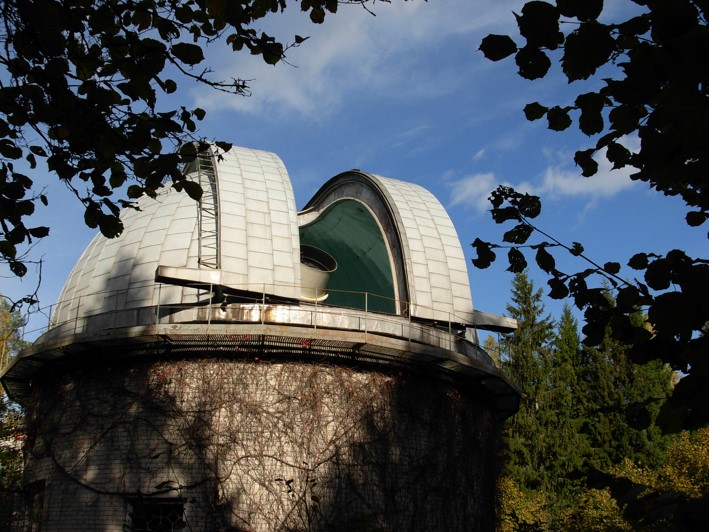
Pictured - the dome of the Baldone Observatory Schmidt telescope
Schmidt telescope
The Baldone Observatory telescope belongs to the Schmidt system of mirror telescopes, which are characterized by a large field of view. The diameter of its field of view is almost five degrees of arc, which approximately corresponds to 10 lunar disks arranged in a row. With the Schmidt telescope, you can quickly review relatively large areas of the sky to find interesting objects for detailed study.
The diameter of the Baldone Schmidt telescope mirror is 120 cm, but due to the specifics of the optical system, the diameter of the entrance opening, or so-called correction plate, is smaller - 80 cm. It is the largest optical telescope in Latvia and the 12th largest Schmidt telescope in the world.
Using the images obtained with the Baldone Schmidt telescope, it is possible to measure both the coordinates of stars and, by selecting appropriate light filters, to measure the brightness of stars and area-shaped objects (comets, nebulae, galaxies) in different wavelength ranges. Using the spectral images, which are obtained by placing an 80 cm diameter four-degree prism in front of the correction plate, it is possible to classify stellar spectra and estimate some parameters of stellar atmospheres.
The Baldone Schmidt telescope began operation in 1967. By 2004, 22,623 astronomical photographic plates (direct, not spectral images) had been taken, which are now digitized and available to Latvian and world astronomers, who can analyze objects and changes in these areas of the sky over a period of almost 40 years.
In 2005, the telescope's main mirror was re-aluminized. In 2006, the telescope was equipped with a SBIG CCD camera with a field of view of 12' x 20'. In 2017, it was replaced with two 16.8 Mpix CCD cameras STX-16803, each with a field of view of one square degree. In 2024, installation of two more sensitive CCD cameras Aluma AC-4040 C2 with a quantum efficiency of 90% was finished, other parameters remained unchanged.
Research on small bodies of the Solar System
The Baldone Schmidt telescope has been used for astrometric measurements - determining the coordinates of several small planets and comets, Pluto, as well as stars. In 2008, research on small bodies of the Solar System using a CCD camera began. In the first year, 12 asteroids were discovered, including 2008 OS9, which approaches Earth to within 9 million kilometers and is a so-called Near Earth Object. By the end of 2025, the number of asteroids discovered at the Baldone Observatory has increased to 149. The largest and most interesting is the centaur-type asteroid with a diameter of 32 km, whose name Orius is associated with the ancient Greek myths about centaurs.
In 2016, the study of minor planets - asteroids of the Solar System was recognized as one of the most important fundamental and applied studies of the year in Latvia. Halley, Wilson-Bappu, Kohoutek, Vest and many other comets have also been studied, mainly in international cooperation programs.
Novae studies in the Andromeda Galaxy
In collaboration with astronomers from Moscow State University, systematic searches and photometric studies of novae in the Andromeda Galaxy M31 were carried out from 1967 to 2004. 70 novae were discovered and their brightness change curves determined. It helped to clarify the relationship between the decay of the nova's brightness after the flare and the maximum brightness during the flare. This helped to create an understanding that the novae in the post-flare phase are sources of soft X-ray radiation in galaxies. Currently, these studies have been suspended due to the small field of view of the CCD camera.
Carbon star studies
The largest work at the Baldone Observatory has been carried out in the study of carbon stars in our Galaxy. Carbon stars are red giants in the late stage of evolution, whose atmosphere contains more carbon than oxygen, hence the name. It is known that most carbon stars are concentrated near the Galactic equator.
In order to cover a larger number of objects in the Schmidt telescope's observations, the sky regions in the Galactic equator zone in the constellation Cygnus around 90 degrees of galactic longitude and in the direction of the Galactic anticenter around 180 degrees of galactic longitude were selected for the studies. In most cases, one or a few observations are not enough to characterize the brightness of a carbon star, as the brightness of these stars varies within quite large limits. Therefore, the selected areas have been photographed every season for decades. Four intervals of the optical spectrum were used for these studies, corresponding to blue, visual, red and infrared light. From this point of view, the Schmidt telescope's photographic plate collection is unique.
To identify and select the carbon stars to be studied, spectral images were initially obtained with a 4-degree objective prism, creating a spectral sky survey of the relevant sky regions. 318 previously unregistered carbon stars were discovered at the Baldone Observatory and a catalogue of these stars was compiled, which is now available in electronic form at the Strasbourg Astronomical Data Center. After the installation of the CCD camere with the Schmidt telescope in 2007-2013 another 56 carbon stars were discovered near the celestial North Pole.
The coolest carbon stars are in a late stage of development, they have a large, thin atmosphere that pulsates, expanding and contracting more or less periodically, thus changing the brightness of these stars, and stars of this type are known as long-period variables. From stars with long pulsation periods, atmospheric material flows into the surrounding space, forming dust shells around the stars, which in turn replenish the matter in interstellar space. Thus, pulsating carbon stars enrich the interstellar medium with carbon.
Initial observations showed the variety and peculiarities of stellar brightness variability. The most interesting carbon stars were selected for further observation, and they have a series of observations of about 30 years. As an example, let's look at how the brightness of the long-period carbon variable star V644 Cyg has changed. In addition to the 578-day brightness fluctuations, which theorists explain as the star's atmospheric oscillations, there are also much slower secondary changes - brightness decrease, the amplitude of which for this star is at least as large as the average amplitude of the periodic changes. The cause of the slow brightness change is not clear; it could be caused by dust escaping from the star, obscuring the star itself.